
What Is Managed Farmland? Complete Guide for First-Time Buyers
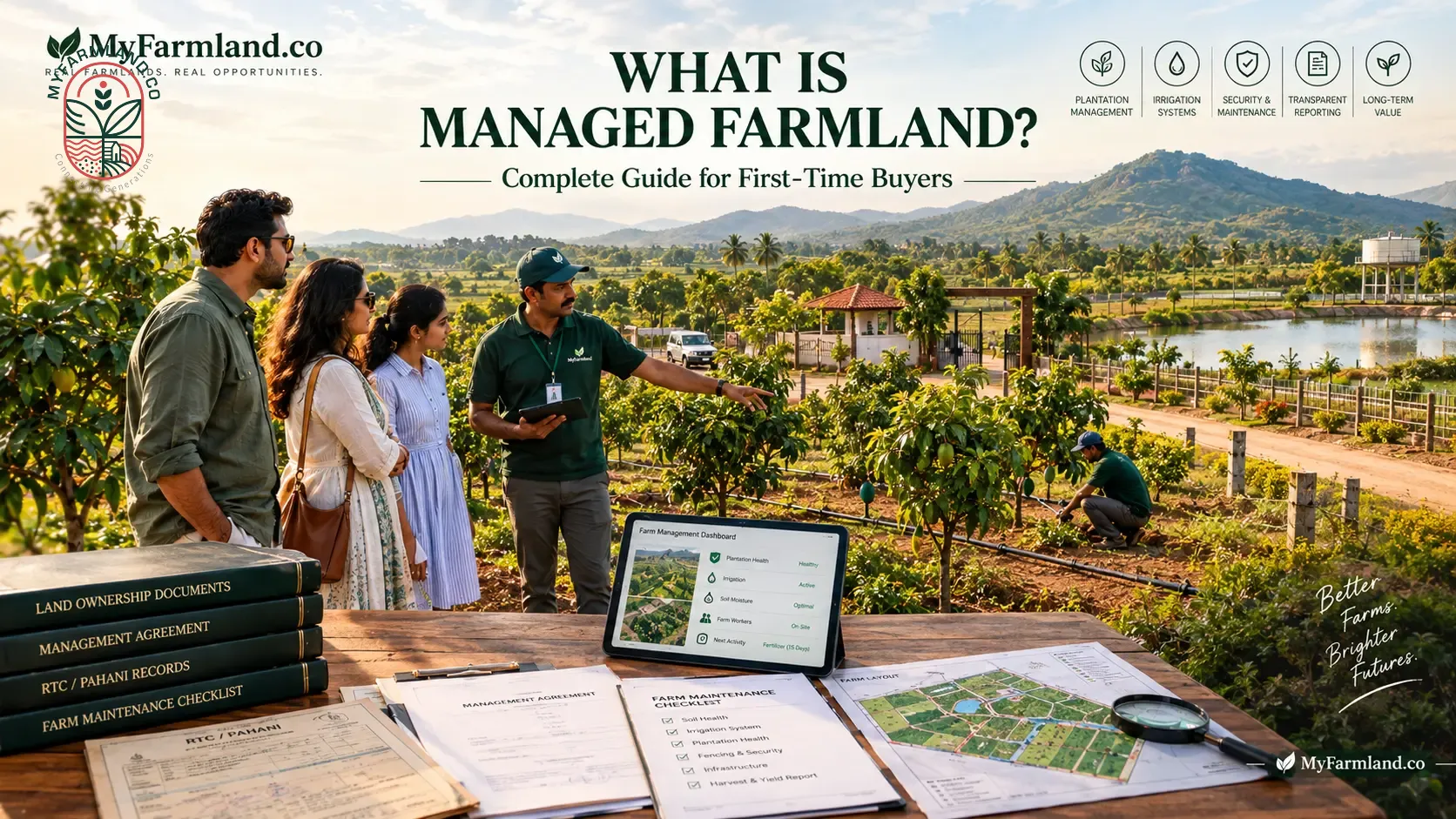
But the term “managed farmland” is not a legal classification by itself. Different developers and projects may use the term differently. Therefore, buyers should understand exactly what is included before making a purchase.
This guide explains what managed farmland means, how it works, what services may be provided, what documents buyers should verify, and what questions should be asked before purchasing.
What Is Managed Farmland?
Managed farmland is agricultural land that is developed or operated with organized services intended to make ownership and farm management more convenient.
Depending on the project, management services may include:
- Land preparation
- Plantation planning
- Tree or crop maintenance
- Irrigation management
- Drip irrigation
- Fencing
- Internal roads
- Security
- Common-area maintenance
- Water management
- Farm supervision
- Organic farming support
- Harvest coordination
- Community facilities
- Farmstay or agro-tourism facilities where legally permitted
The exact services vary significantly from one project to another.
Therefore, buyers should never assume that every managed farmland project provides the same facilities or services.
Managed Farmland vs Traditional Farmland
One of the easiest ways to understand managed farmland is to compare it with independently owned agricultural land.
| Feature | Traditional Farmland | Managed Farmland |
|---|---|---|
| Land ownership | Buyer owns land | Buyer owns land, subject to project structure |
| Farm management | Usually buyer's responsibility | May be handled by a management team |
| Plantation | Buyer arranges | May be planned/provided |
| Maintenance | Buyer manages | May be included |
| Security | Usually self-managed | May be community-managed |
| Internal roads | Depends on property | May be developed |
| Irrigation | Buyer responsibility | May be organized |
| Community facilities | Usually limited | May be available |
| Farm supervision | Usually owner-managed | May be provided |
| Annual maintenance | Varies | Often charged separately |
| Ease of ownership | More hands-on | Potentially more organized |
| Contract terms | Mostly land transaction | Land + management/service terms may apply |
The important point is that managed farmland does not automatically mean hassle-free farmland.
The buyer still needs to verify ownership, title, land records, land use, access, water and other legal and physical aspects.
Why Are Buyers Interested in Managed Farmland?
There are several reasons buyers may consider managed farmland.
1. Less Day-to-Day Farm Management
Agriculture requires regular attention.
Irrigation, pruning, fertilization, pest management, fencing, maintenance and harvesting can require time and local knowledge.
A professionally managed arrangement may reduce the amount of day-to-day involvement required from the landowner.
However, buyers should verify whether these services are actually included in the agreement.
2. Organized Farm Development
A managed project may have a common development plan covering:
- Internal roads
- Water systems
- Plantation
- Fencing
- Security
- Drainage
- Electricity
- Common areas
- Farm infrastructure
This can create a more organized ownership experience than purchasing an isolated agricultural parcel.
The quality of these facilities, however, depends on the individual project.
3. Farming Support
Some projects provide agricultural support such as crop planning, plantation maintenance or farm supervision.
Agricultural research organizations such as ICAR emphasize location-specific farming practices, resource management, soil health and efficient water use as important components of sustainable agricultural production.
This means buyers should not look only at the appearance of a developed farm. They should also understand how the agricultural activity will actually be maintained.
What Can Be Included in a Managed Farmland Project?
There is no single standard package.
A project may provide some of the following:
Land Development
- Site preparation
- Boundary demarcation
- Internal roads
- Drainage
- Landscaping
Agricultural Development
- Fruit trees
- Timber trees
- Medicinal plants
- Vegetable cultivation
- Organic farming
- Intercropping
- Irrigation systems
Infrastructure
- Electricity
- Water storage
- Borewell or other water sources
- Drip irrigation
- Fencing
- Security
- Farm office
Community Facilities
Depending on the project and applicable permissions, facilities may include:
- Clubhouse
- Swimming pool
- Sports areas
- Common gathering spaces
- Farmstay facilities
- Workspaces
- Recreation areas
These facilities should be treated as project-specific features rather than standard features of managed farmland.
Is Managed Farmland the Same as a Resort?
No.
This is an important distinction for buyers.
A managed farmland project may provide recreational or hospitality facilities, but the underlying property and its permitted use must still be understood separately.
A project may have farmland as its primary property offering while providing certain common amenities or hospitality facilities.
Buyers should therefore ask:
What exactly am I purchasing — agricultural land, a plot within a managed agricultural project, a membership, a lease, or another contractual interest?
The sale agreement and title documents should clearly answer this question.
Can You Build a House on Managed Farmland?
This is one of the most important questions buyers ask.
The answer should not be assumed from marketing material.
Agricultural land cannot simply be treated as residential land because a project brochure shows a farmhouse, cottage or villa.
In Karnataka, the Karnataka Land Revenue Act contains provisions governing diversion/use of agricultural land for other purposes, and the law provides consequences for unauthorized diversion.
The rules and permissions applicable to a particular construction can depend on:
- Land classification
- Location
- Local planning authority
- Conversion status
- Applicable development regulations
- Nature of proposed construction
- Project approvals
- Local building permissions
Therefore, before purchasing, ask the developer:
“Can I construct on my individual plot?”
Then ask:
- What type of construction is permitted?
- Is land conversion required?
- Has the required conversion already been obtained?
- Which authority grants the building permission?
- Is construction allowed for third-party contractors?
- Does the developer provide construction?
- Are there restrictions on the size or type of structure?
- Are farmstay or rental activities legally permitted?
Get the answer in writing.
How Does Managed Farmland Work?
A typical managed farmland model may look like this:
Step 1 — Select the Land
The buyer selects a plot within the project.
Step 2 — Verify the Property
The buyer or independent lawyer checks:
- Title
- RTC/Pahani
- Encumbrance Certificate
- Survey number
- Mutation
- Land classification
- Access
- Conversion status where relevant
- Litigation
- Acquisition restrictions
Step 3 — Purchase
The transaction is completed according to the applicable sale and registration process.
Step 4 — Farm Development
The project management team may develop the agricultural infrastructure.
Step 5 — Plantation or Farming
The agreed crops or trees may be planted and maintained.
Step 6 — Ongoing Management
The management team may handle agreed services such as irrigation, maintenance, security and farm supervision.
Step 7 — Harvest or Other Services
Depending on the project, the owner may receive agricultural produce or other services specified in the agreement.
The exact process varies from project to project.
What Should You Check Before Buying Managed Farmland?
Do not evaluate a managed farmland project only by looking at amenities.
Use two separate checklists:
A. Legal Due Diligence
Verify:
- Sale deed
- Previous title documents
- RTC/Pahani
- Mutation records
- Encumbrance Certificate
- Survey number
- Survey sketch
- Land classification
- Conversion status, if applicable
- Litigation
- Acquisition notifications
- Legal access road
- Seller/developer authority
- Registration details
You can refer to our earlier guide:
Farmland Buying Checklist: 15 Documents to Check Before Buying Land in India
B. Project Due Diligence
Then evaluate the actual managed-farmland offering.
Ask:
- Who owns the land?
- Who manages the farm?
- Who maintains the trees?
- What crops will be planted?
- Who pays for planting?
- Who pays for replacement of dead plants?
- Who owns the produce?
- How is harvesting handled?
- Is there an annual maintenance fee?
- What happens if management services stop?
- Is there a management agreement?
- How long is the management agreement?
- Can the agreement be terminated?
- Can the land be sold independently?
- Can the buyer appoint another farm manager?
- Who maintains common infrastructure?
These questions can reveal the difference between a genuinely managed agricultural project and a project that simply uses the term “managed farmland” in its marketing.
What About Water?
Water is one of the most important factors in agricultural land.
A beautiful project with attractive landscaping does not automatically mean it has a sustainable water source.
Ask for specific information about:
- Borewells
- Open wells
- Ponds
- Rainwater harvesting
- Irrigation systems
- Water storage
- Drip irrigation
- Water availability during summer
- Individual vs common water supply
- Maintenance responsibility
ICAR research and agricultural guidance emphasize efficient water management, rainwater harvesting and water-use efficiency as important components of sustainable agriculture.
Whenever possible, inspect the water infrastructure physically rather than relying only on photographs or verbal assurances.
How Much Does Managed Farmland Cost?
There is no single price for managed farmland.
Pricing can depend on:
- Location
- Distance from major cities
- Road connectivity
- Land size
- Project size
- Development level
- Water availability
- Plantation
- Infrastructure
- Amenities
- Developer
- Legal status
- Maintenance structure
The quoted price may also exclude additional expenses.
Therefore, calculate the total acquisition cost, including:
- Land price
- Registration
- Stamp duty
- Legal verification
- Documentation
- Development charges
- Maintenance
- Water charges
- Infrastructure charges
- Construction, if permitted
- Other project-specific fees
Do not compare two projects using only their advertised price per square foot.
Managed Farmland and Investment: What Should Buyers Understand?
Managed farmland can have multiple potential value drivers, but buyers should distinguish between potential and guaranteed returns.
Potential factors can include:
- Location development
- Infrastructure expansion
- Agricultural productivity
- Land demand
- Improved farm development
- Tourism or farmstay demand where permitted
- Scarcity of suitable land
- Long-term surrounding development
However, none of these automatically guarantees appreciation or income.
Agricultural production also involves risks such as:
- Weather
- Water availability
- Crop disease
- Pest problems
- Labour costs
- Input costs
- Market prices
- Management quality
ICAR research highlights the importance of climate-resilient agriculture, water management and diversified farming practices in addressing agricultural risks.
Therefore, a managed farmland purchase should be evaluated as a combination of land ownership + agricultural activity + management arrangement, rather than as a guaranteed-return financial product.
Who May Consider Managed Farmland?
Managed farmland may be relevant to people who:
Want Land but Have Limited Time
People living in cities may not be able to visit and manage a farm regularly.
Want an Agricultural Lifestyle
Some buyers may want to spend weekends or holidays around a farm environment.
Want Organized Farm Maintenance
Buyers who prefer professional or community-level management may consider this structure.
Live Away From the Property
Owners living in another city or country may value local management support, subject to the exact legal and contractual structure.
Want a Long-Term Agricultural Asset
Some buyers may be interested in owning land while maintaining agricultural activity on it.
But suitability depends on the buyer's objectives, budget, risk tolerance and the specific project's legal and management terms.
12 Questions to Ask a Managed Farmland Developer
Before paying a booking amount, ask these questions:
- Who is the legal owner of the land?
- What exactly will be registered in my name?
- What is the survey number?
- Can I independently verify the title?
- Is the land agricultural or converted?
- What farming activity will be carried out?
- Who manages the farm?
- What services are included in the management fee?
- What is the annual maintenance cost?
- Who owns the agricultural produce?
- Can I sell my land independently?
- What happens if I no longer want the management service?
If the answers are unclear, request the documents and agreements before proceeding.
Managed Farmland Red Flags
Be cautious if a project:
- Promises guaranteed appreciation
- Promises guaranteed monthly income without clear contractual terms
- Avoids sharing title documents
- Cannot provide survey details
- Gives only verbal answers about construction
- Uses “farmhouse” or “villa” language without explaining approvals
- Does not explain maintenance charges
- Has unclear ownership
- Does not explain exit or resale procedures
- Pressures you to pay immediately
- Provides unusually high return projections without assumptions
A professional buying process should allow sufficient time for document verification.
Managed Farmland Buyer Checklist
Before buying, make sure you can answer YES to the following:
| Question | Checked? |
|---|---|
| Do I know the exact survey number? | ☐ |
| Have I verified ownership? | ☐ |
| Have I checked the title chain? | ☐ |
| Have I reviewed the RTC/Pahani? | ☐ |
| Have I checked the EC? | ☐ |
| Have I physically inspected the property? | ☐ |
| Is the access road legally established? | ☐ |
| Have I checked the land classification? | ☐ |
| Have I verified water availability? | ☐ |
| Do I understand the management agreement? | ☐ |
| Do I know the annual maintenance cost? | ☐ |
| Do I understand construction restrictions? | ☐ |
| Do I know who manages the farm? | ☐ |
| Do I know who owns the agricultural produce? | ☐ |
| Have I calculated the complete purchase cost? | ☐ |
| Has an independent lawyer reviewed the documents? | ☐ |
Managed Farmland Near Bangalore
For buyers searching for managed farmland near Bangalore, location can be an important part of the evaluation.
Popular search areas may include:
- Hosur
- Denkanikottai
- Athimugam
- Anekal
- Kanakapura
- Ramanagara
- Chikkaballapur
- Nandi Hills
- Devanahalli
- Doddaballapur
But proximity to Bangalore alone should not determine a purchase.
A project should be evaluated based on its legal status, connectivity, water, land quality, development, management structure and total cost.
Frequently Asked Questions
What is managed farmland?
Managed farmland is agricultural land associated with organized farm-management or maintenance services. The exact services differ between projects.
Is managed farmland the same as agricultural land?
Not necessarily. “Managed farmland” describes the way a property or farm may be operated; it is not itself a substitute for checking the property's legal land classification and title.
Is managed farmland a guaranteed investment?
No. Land appreciation, agricultural income and other returns are not guaranteed.
Can I build a farmhouse on managed farmland?
Do not assume so. Construction depends on applicable land-use rules, permissions, conversion status and local regulations.
Who maintains the farmland?
It depends on the management agreement. Some projects provide ongoing farm maintenance while others may only provide initial development.
Do managed farmland projects have maintenance fees?
Many projects may have ongoing maintenance or management charges, but the amount and services vary. Buyers should obtain the fee structure in writing.
Can I sell managed farmland later?
The resale process depends on the ownership structure, sale agreement, project rules and applicable law. Ask the developer for the exact resale procedure before purchasing.
Is managed farmland suitable for first-time buyers?
It can be considered by first-time buyers who prefer organized farm management, but the buyer should still conduct independent legal, physical and financial due diligence.
Final Thoughts
Managed farmland can offer a different ownership model by combining agricultural land with organized development and farm-management services.
The key is to understand what you are actually buying and what you are actually receiving.
Do not evaluate a project only by:
- Price per square foot
- Number of amenities
- Promotional returns
- Distance from Bangalore
- Project photographs
Instead, evaluate:
Title + Land Records + Access + Water + Land Use + Infrastructure + Management Agreement + Total Cost.
A well-presented project still requires independent verification.
For buyers exploring farmland opportunities, a marketplace such as MyFarmland.co can help with the initial discovery and comparison of farmland projects, while legal and technical due diligence should be conducted independently before purchase.
Suggested Internal Links
To strengthen the MyFarmland.co topic cluster, link this article to:
- How to Buy Farmland in Karnataka: Complete Legal Guide
- Farmland Buying Checklist: 15 Documents to Check Before Buying
- How to Verify Farmland Before Buying
- Farmland Investment in Karnataka: 10 Things Buyers Must Know
- Farmland vs Urban Plots: Investment Comparison
- How Much Does Farmland Cost Near Bangalore in 2026?
- 10 Best Farmland Locations Near Bangalore in 2026
Use descriptive anchor text such as:
- “farmland buying checklist”
- “verify farmland before buying”
- “farmland investment in Karnataka”
- “farmland near Bangalore”
- “managed farmland projects”
SEO FAQ Schema Questions
What is managed farmland?
Managed farmland is agricultural land associated with organized services such as farm maintenance, plantation management, irrigation support, security or common infrastructure.
Is managed farmland a good investment?
Its suitability depends on the location, legal status, purchase price, agricultural plan, management structure, risks and the buyer's objectives. Appreciation or income should not be treated as guaranteed.
Can I construct a house on managed farmland?
Construction should only be considered after verifying the applicable land-use rules, conversion status and required permissions for the specific property.
What documents should I check before buying managed farmland?
Buyers should examine title documents, RTC/Pahani, EC, mutation records, survey documents, access rights, land classification, applicable conversion/permissions and project agreements.
Legal Disclaimer
This article is intended for general educational and informational purposes only. Land laws, planning regulations, permissions and transaction requirements can change and may vary depending on the location and nature of the property. Buyers should independently verify the latest applicable rules and obtain advice from a qualified property lawyer and relevant authorities before purchasing land.
The Karnataka Land Revenue Act contains provisions concerning the use/diversion of agricultural land for non-agricultural purposes, including consequences for unauthorized diversion.