
The Land Equation: Understanding the Economics Behind Farmland Appreciation.
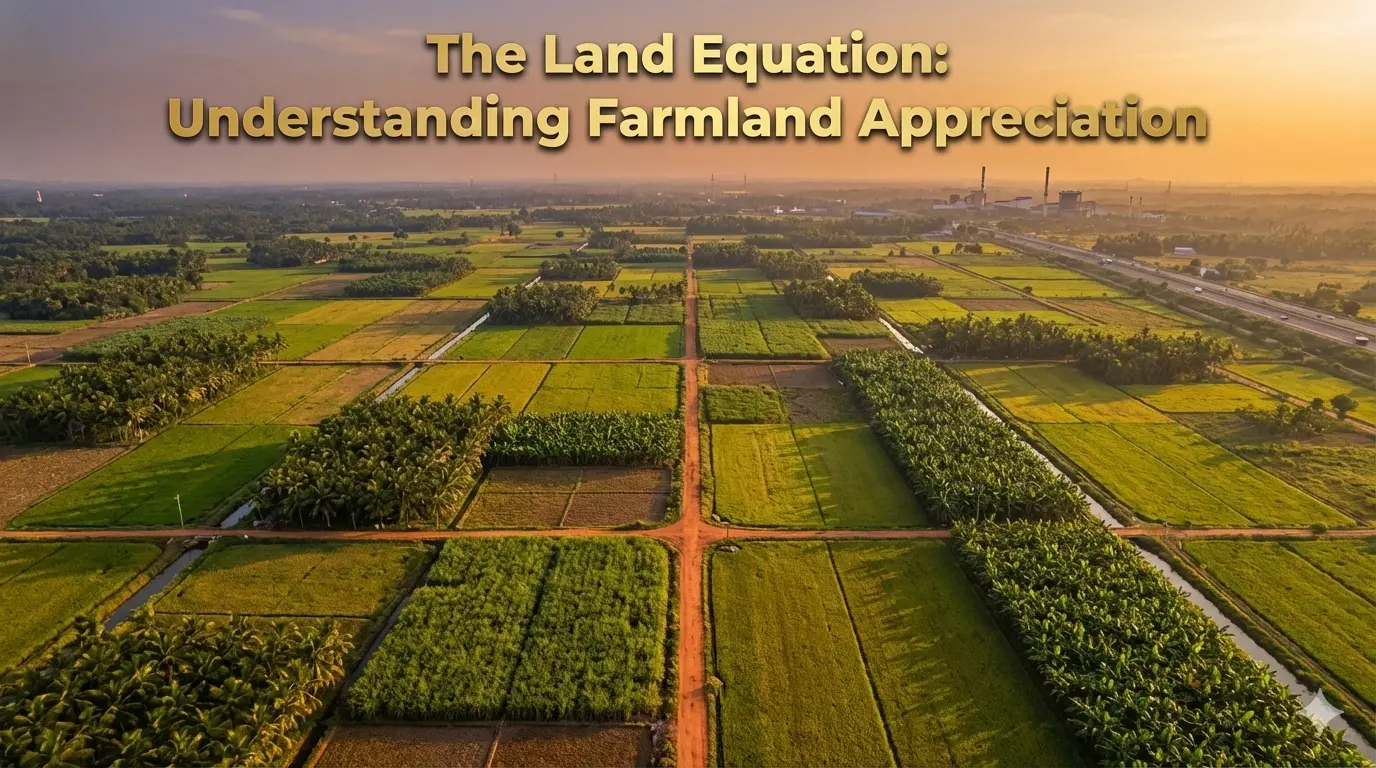
1️⃣ Land Is a Fixed Supply Asset
Unlike stocks, companies, or currencies, land cannot be manufactured.
- Governments cannot create more agricultural land.
- Developers cannot “produce” additional natural acreage.
- Supply remains constant — or decreases due to urban conversion.
In economic terms, farmland has inelastic supply.
When supply is fixed and demand increases, prices naturally adjust upward over time.
2️⃣ Urban Expansion Is Inevitable
Cities do not shrink — they expand outward.
As urban centers grow:
- Infrastructure spreads
- Roads extend
- Industrial hubs shift
- Residential demand pushes outward
This outward movement gradually influences peri-urban farmland.
Land that once seemed “far” becomes strategically located over time.
Farmland appreciation often begins quietly at the edges of growth corridors.
3️⃣ Infrastructure Multiplier Effect
One major infrastructure project can permanently alter land value.
Examples:
- New highways
- Ring roads
- Industrial corridors
- Logistics parks
- Technology hubs
Infrastructure reduces travel time, increases accessibility, and enhances usability.
Farmland near infrastructure doesn’t just gain convenience — it gains economic relevance.
4️⃣ Agricultural Relevance Never Disappears
Unlike certain commercial assets that become outdated, farmland retains intrinsic purpose:
- Food production
- Plantation cultivation
- Agri-business opportunities
- Resource management
Even if development never reaches it, farmland maintains fundamental utility.
That base utility acts as a floor to long-term value.
5️⃣ Inflation and Hard Assets
In inflationary environments:
- Currency weakens.
- Construction costs rise.
- Tangible assets become more attractive.
Land historically behaves as a hedge because:
- Replacement cost increases.
- Demand for physical assets strengthens.
- Scarcity becomes more visible.
Farmland, as raw land, benefits from this long-term dynamic.
6️⃣ Low Depreciation Risk
Apartments depreciate structurally. Commercial buildings age. Technology becomes obsolete.
But farmland does not “wear out” in the same way.
With proper care:
- Soil remains productive.
- Boundaries remain stable.
- Utility remains intact.
This lowers structural depreciation risk compared to built real estate.
7️⃣ Demographic Pressure
India’s population continues to grow. Urbanization continues. Food demand increases.
As demand for both housing and agriculture rises, land becomes a strategic resource.
This dual pressure supports long-term appreciation.
8️⃣ The Psychological Premium of Ownership
There is also a behavioral factor:
Investors value tangible control.
Land ownership provides:
- Visibility
- Physical security
- Long-term stability perception
This psychological preference sustains demand even during volatile periods.
9️⃣ The Time Multiplier
Farmland rarely doubles overnight.
Its strength lies in:
- Gradual infrastructure spillover
- Long-term scarcity recognition
- Compound appreciation
Investors who align with regional growth cycles often capture this multiplier effect.
🔟 The Discipline Advantage
Because farmland doesn’t fluctuate daily, it discourages impulsive exits.
This forced patience:
- Reduces emotional decision-making
- Encourages long holding periods
- Allows appreciation cycles to mature
Sometimes, the asset protects the investor from their own impatience.
Final Perspective
Farmland appreciation is not magic. It is mathematics.
It is the intersection of:
- Fixed supply
- Expanding demand
- Infrastructure growth
- Inflation dynamics
- Time
When these forces combine, land value adjusts.
Not dramatically. But structurally.
Farmland is not about speed. It is about positioning.
And those who understand the land equation don’t chase returns — they align with inevitabilities.