
How to Verify Farmland Before Buying: A Complete Land Due Diligence Guide
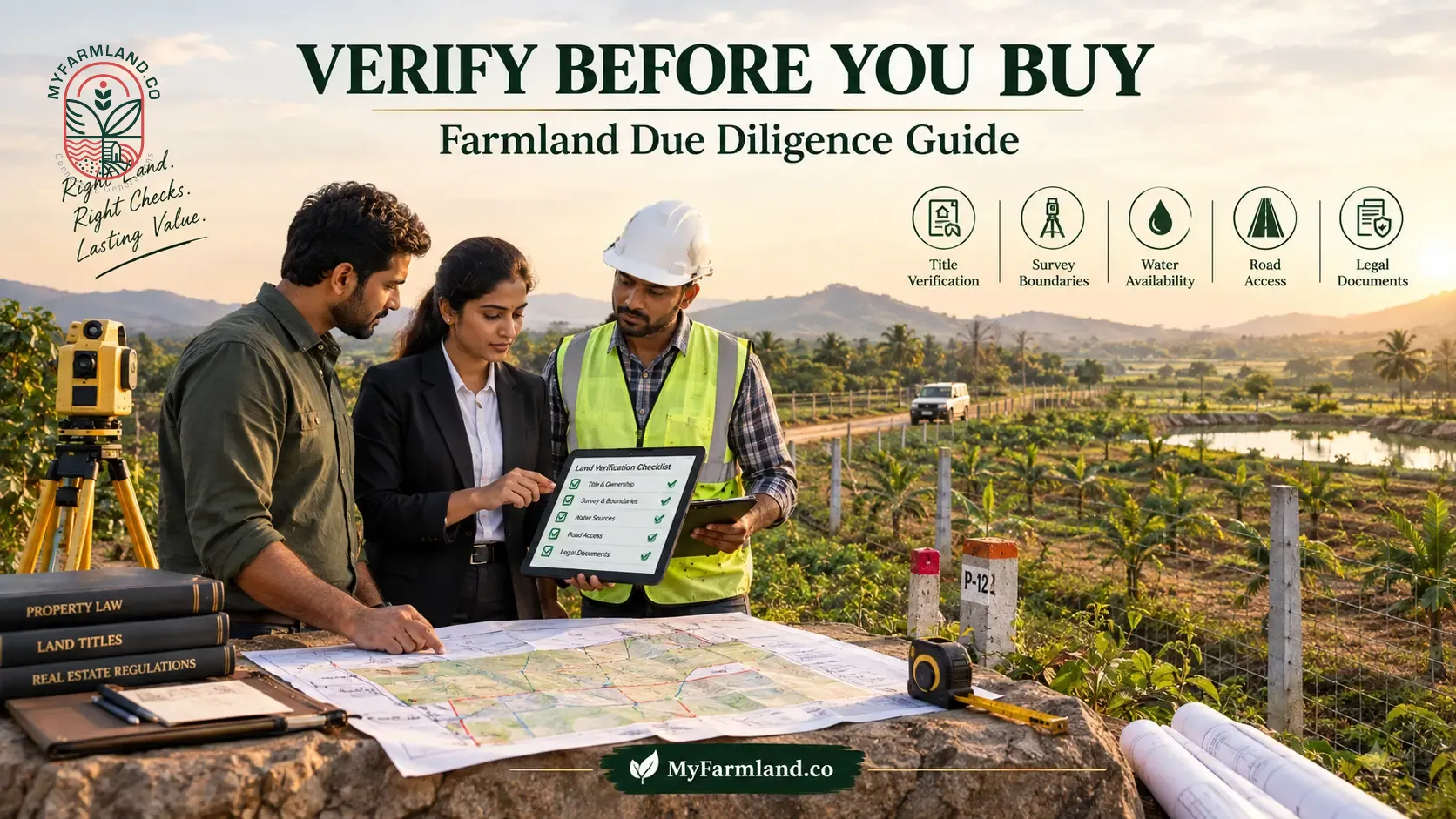
How to Verify Farmland Before Buying in India
Buying farmland can be an exciting opportunity.
You may imagine owning a piece of green land, growing trees, spending weekends in nature or simply holding agricultural land as a long-term asset.
But before paying an advance, there is one thing that should come before everything else:
Due diligence.
A beautiful property, attractive location and convincing sales presentation cannot replace proper verification.
Before purchasing farmland, you should understand:
Who owns the land? What exactly are you buying? Can the seller legally sell it? What is the land classified as? Is there legal access? Are there encumbrances or disputes? What can you legally do with the land?
This guide explains a practical framework for checking farmland before purchase.
1. Start With the Exact Survey Number
One of the first things you should obtain from the seller is the property's exact survey number and subdivision details, where applicable.
Don't verify a property using only:
- Google Maps location
- A pin dropped on a map
- A brochure
- A project name
- A verbal description
The legal identity of land is tied to its official records.
You need to establish exactly which parcel you're purchasing.
Ask for:
- Survey number
- Subdivision number
- Village
- Taluk
- District
- Total extent
- Boundaries
Then match those details against the official land records.
2. Verify the Seller's Ownership
The person selling the farmland should have the legal right to sell it.
Ask:
Who is the registered owner?
Then compare the seller's identity with the ownership documents.
If the property has multiple owners, all relevant ownership interests need to be understood.
Be particularly careful when dealing with:
- Joint ownership
- Inherited property
- Power of Attorney
- Family settlements
- Partitioned property
- Recently transferred land
Never assume that the person negotiating with you is automatically the legal owner.
3. Examine the Sale Deed
The current sale deed is one of the most important documents in your due diligence.
Check:
- Seller name
- Buyer name
- Survey number
- Property extent
- Boundaries
- Consideration
- Registration details
- Previous ownership references
The description in the deed should correspond with the actual property you're purchasing.
A mismatch between the document and the physical property deserves further investigation.
4. Check the Previous Title Documents
Don't stop with the current sale deed.
You may need to examine the chain of title to understand how ownership passed from previous owners to the current owner.
Depending on the property, this may involve documents such as:
- Previous sale deeds
- Partition deeds
- Gift deeds
- Release deeds
- Inheritance documents
- Court orders
- Settlement deeds
The exact documents required depend on the property's history.
A property with a long, properly documented ownership chain is easier to evaluate than one with unexplained gaps.
5. Check the Encumbrance Certificate
An Encumbrance Certificate (EC) can help identify registered transactions and certain registered encumbrances relating to the property for the period covered by the certificate.
But don't treat an EC as a complete substitute for title due diligence.
Your lawyer should review:
- The EC period
- Registered transactions
- Mortgages/charges appearing in the records
- Previous transfers
- Whether the search period is sufficient
An EC showing no entries does not by itself prove that there are no possible legal issues.
6. Verify RTC / Pahani or Applicable Land Records
For agricultural land, revenue records can be particularly important.
In Karnataka, buyers commonly encounter records such as RTC/Pahani.
These records can contain information relating to the land and its cultivation/revenue history.
Check whether the records correspond with:
- Survey number
- Extent
- Owner/khatedar details
- Land classification/use information
- Cultivation details, where applicable
Don't rely on an old printout.
Verify the current record through the appropriate government system or office.
7. Check Mutation Records
When ownership or other relevant rights change, revenue records may be updated through mutation.
Check the mutation history to understand whether the current ownership reflected in revenue records is consistent with the registered documents.
If you find unexplained discrepancies between:
Sale deed → RTC/Pahani → Mutation records
pause the transaction and get professional advice.
8. Conduct a Physical Land Survey
Documents are only one part of due diligence.
You should also verify the physical property.
A licensed or qualified survey professional can help establish whether the property on the ground corresponds with the documented boundaries.
Check:
- Boundary stones
- Survey lines
- Extent
- Neighbouring properties
- Existing structures
- Roads
- Fencing
- Water sources
This is especially important when purchasing large agricultural parcels.
9. Verify Legal Access to the Property
This is one of the most overlooked checks.
A property may appear to have a road on Google Maps or in a brochure.
That doesn't automatically establish the legal right to use that road.
Ask:
Is the road publicly owned?
Or:
Is it private land?
If access passes through another person's property, understand the legal basis for that access.
Check relevant:
- Revenue records
- Registered easements/right-of-way documents
- Layout/project documents, where applicable
- Survey records
- Physical access
Physical access and legal access are not always the same thing.
10. Check Land Classification
Before purchasing farmland, understand its legal classification.
Agricultural land is not automatically equivalent to:
- Residential land
- Commercial land
- Resort land
- Industrial land
The rules vary by state.
If someone tells you:
"You can build anything here."
don't rely on the statement.
Ask:
What is legally permitted on this particular parcel?
11. Understand Conversion / Diversion Requirements
In some circumstances, using agricultural land for a non-agricultural purpose may require approval, conversion or compliance with applicable land-use regulations.
The process differs between states and circumstances.
Therefore, before purchasing farmland for a farmhouse, resort, commercial activity or other non-agricultural purpose, verify the applicable rules.
This is especially important if the property's marketing emphasizes:
- Farmhouse construction
- Villas
- Resorts
- Commercial activity
- Rental income
The marketing description does not determine the property's legal land use.
12. Check for Litigation
A property can have ownership documents and still be involved in a dispute.
Ask your lawyer to investigate possible litigation involving:
- Ownership
- Boundaries
- Inheritance
- Partition
- Possession
- Easement/access
- Mortgage
- Family disputes
Don't rely exclusively on the seller's statement that:
"There is no case."
Independent verification is important.
13. Check for Government Acquisition or Restrictions
Before purchasing, investigate whether the land may be affected by:
- Government acquisition
- Infrastructure projects
- Road widening
- Planning proposals
- Environmental restrictions
- Forest-related restrictions
- Other statutory limitations
The exact checks depend on the location.
This is particularly important in areas experiencing rapid infrastructure development.
14. Verify Water Availability
For farmland, water deserves its own due-diligence category.
Ask:
- What is the current water source?
- Is there a borewell?
- Is there an open well?
- Is irrigation available?
- What is the water storage arrangement?
- Is the water source shared?
- Who owns the water infrastructure?
- What happens during dry periods?
Don't treat a claim such as "good groundwater" as proof.
Verify the actual situation on site.
15. Check Electricity and Infrastructure
If you are purchasing a managed farmland or developed agricultural property, understand exactly what infrastructure exists.
Check:
- Electricity connection
- Internal roads
- Drainage
- Fencing
- Water tanks
- Security
- Farm infrastructure
Most importantly:
Determine who owns and maintains the infrastructure.
Is it:
- Included in your purchase?
- Common infrastructure?
- Maintained by a management company?
- Subject to recurring fees?
Read the agreement.
16. Verify the Project Developer
If you're buying a plot inside a managed farmland community, your due diligence shouldn't stop with the individual land parcel.
Also investigate the developer/operator.
Look at:
- Company identity
- Ownership structure
- Previous projects
- Agreements
- Development promises
- Maintenance arrangements
- Project approvals, where applicable
- Customer documentation
Visit completed projects if possible.
A brochure can show you what a project is supposed to become.
A completed project can show you what the developer actually delivered.
17. Understand Exactly What You Own
This question is surprisingly important.
Ask:
"What exactly will be registered in my name?"
Is it:
- A specific agricultural parcel?
- A subdivided parcel?
- Undivided share?
- A share in a larger property?
- A plot with separate title?
- Another legal structure?
Never assume that a plotted layout automatically means every buyer receives the same type of legal ownership.
Read the agreement and sale deed carefully.
18. Verify All Promised Amenities
If a farmland project advertises:
- Clubhouse
- Swimming pool
- Farmstay
- Restaurant
- Sports facilities
- Children's area
- Plantation
- Water features
- Roads
ask:
Are these already completed?
If not:
Are they contractually committed?
And:
Who will maintain them?
Marketing material and legally enforceable commitments are not necessarily the same thing.
19. Check the Total Cost
The advertised land price may not be your final acquisition cost.
Ask for a written cost sheet covering applicable:
- Land price
- Registration
- Stamp duty
- Development charges
- Infrastructure charges
- Maintenance
- Management fees
- Legal expenses
- Survey expenses
- Other project charges
Calculate the all-in acquisition cost before comparing properties.
20. Ten Red Flags
Be cautious if you encounter:
🚩 1. Pressure to pay immediately
"Book today or lose the price."
🚩 2. No proper documents
"Documents will be shown after booking."
🚩 3. Ownership mismatch
Seller and documents don't match.
🚩 4. Unclear access
"Everyone uses this road."
🚩 5. Unrealistic returns
"Guaranteed 3X in two years."
🚩 6. Vague development promises
"Airport/highway/industrial park is definitely coming."
🚩 7. No survey details
Only a Google Maps pin is provided.
🚩 8. Hidden charges
The advertised price excludes several unexplained fees.
🚩 9. Construction promises without legal clarity
"Build your villa immediately" without explaining applicable land-use permissions.
🚩 10. Refusal to allow independent verification
A genuine transaction should withstand reasonable due diligence.
Farmland Verification Checklist
| Check | What to Verify |
|---|---|
| Ownership | Current legal owner |
| Sale deed | Registered ownership document |
| Title chain | Previous ownership history |
| EC | Registered transactions/encumbrances for the search period |
| RTC/Pahani | Applicable agricultural revenue record |
| Mutation | Revenue ownership updates |
| Survey | Exact boundaries and extent |
| Access | Physical + legal access |
| Classification | Applicable land-use classification |
| Conversion | Whether required for intended use |
| Litigation | Relevant court/dispute checks |
| Acquisition | Government/infrastructure concerns |
| Water | Actual source and availability |
| Infrastructure | Roads, power, fencing, etc. |
| Project documents | Applicable approvals and agreements |
The 24-Hour Rule
One useful principle for farmland buyers:
Never let urgency replace due diligence.
If someone tells you:
"You have to pay today."
your response should be:
"I'll pay after I complete my verification."
A property that is genuinely suitable should still make sense after the documents are reviewed.
Should You Hire a Property Lawyer?
For a significant land purchase, independent professional legal review can be valuable.
The lawyer should not be someone whose only role is completing the seller's transaction.
Ideally, the buyer should have an independent professional review the documents and identify potential issues.
For complex properties, you may also need:
- Land surveyor
- Chartered accountant/tax professional
- Local planning expert
- Other technical professionals
The exact professionals required depend on the property and transaction.
Final Thoughts
Buying farmland isn't simply about finding a beautiful piece of land.
It is about verifying the asset behind the sales pitch.
Before paying an advance, understand:
Who owns it. Where exactly it is. What the documents say. What the land can legally be used for. How you access it. Whether there are disputes or restrictions. What you're actually paying. And what you will own after registration.
Don't verify the promise. Verify the property.
That single principle can help farmland buyers make more informed decisions.
Frequently Asked Questions
How do I verify farmland before buying?
Start by obtaining the exact survey details, verifying ownership and title, checking applicable land records and EC, confirming boundaries and access, understanding land classification, investigating litigation and restrictions, and obtaining independent legal advice.
Is RTC enough to verify agricultural land?
No. RTC/Pahani is an important land record in relevant jurisdictions, but it should be considered alongside title documents, EC, mutation, survey records and other applicable due diligence.
Does an EC prove that farmland has a clear title?
No. An EC is an important part of property due diligence but does not by itself establish complete title.
Can I build a farmhouse on agricultural land?
Do not assume so. Whether construction is permitted depends on the applicable state and local land-use rules, permissions and the circumstances of the specific property.
Should I visit farmland before buying?
Yes. A physical inspection can reveal issues involving boundaries, access, water, neighbouring properties and actual site conditions that documents or photographs may not reveal.
Legal Disclaimer
This article is for general educational purposes and does not constitute legal, financial or investment advice. Property laws, land-use regulations, agricultural land restrictions, conversion procedures and documentation requirements vary by state and location and may change. Buyers should verify current government records and obtain independent professional legal advice before entering into a property transaction.