
How to Check Whether Farmland Is Really a Good Investment Before Buying | MyFarmland.co
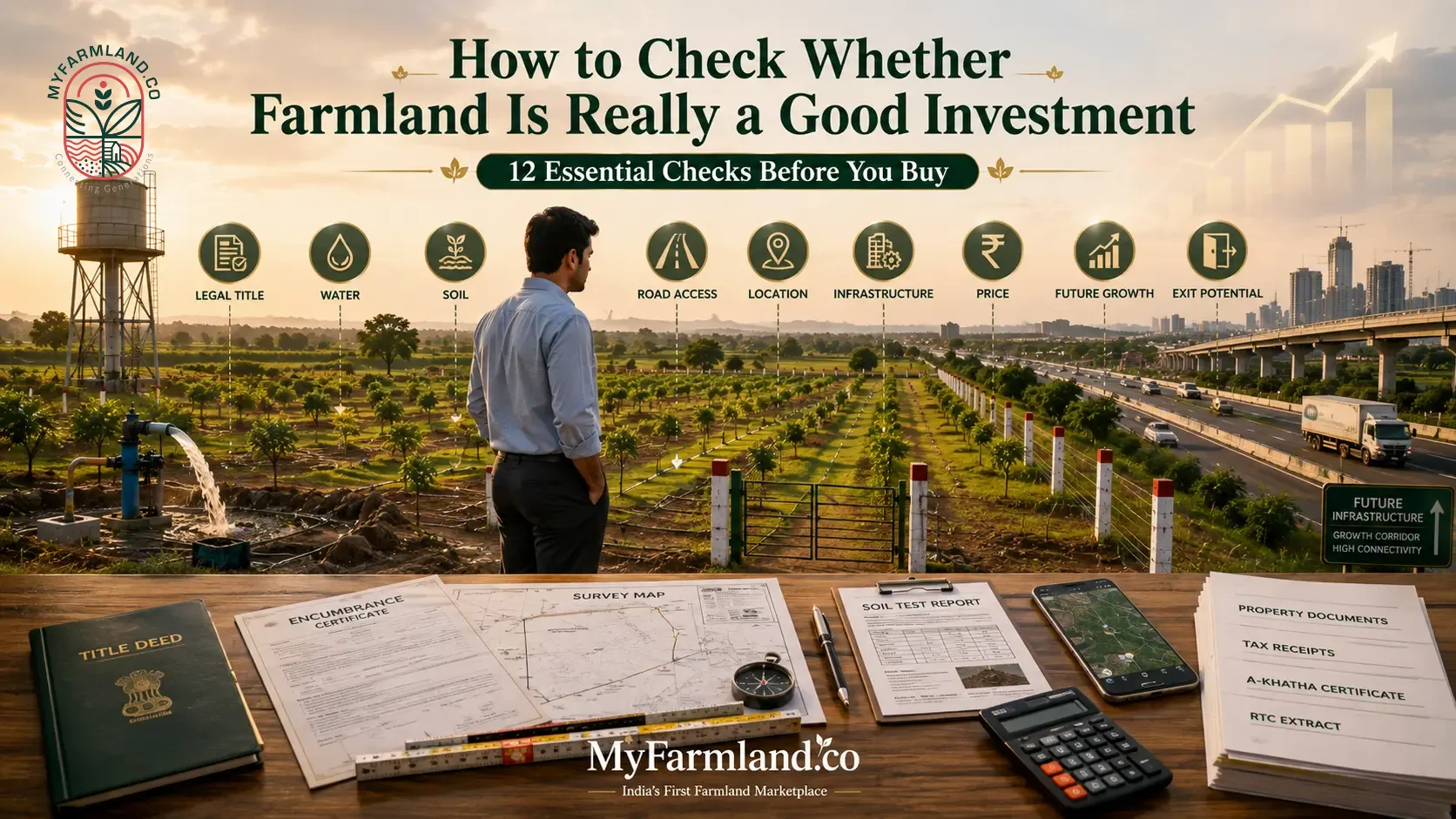
How to Check Whether Farmland Is Really a Good Investment Before Buying
A farmland advertisement can look perfect.
Beautiful green plantations.
Wide roads.
Water features.
A peaceful location.
And perhaps a very attractive price.
But farmland investment isn't about how good the brochure looks.
Before investing your money, you need to answer a much more important question:
Is this farmland actually a good investment?
The answer depends on several factors, including legal ownership, location, water, accessibility, soil quality, infrastructure, pricing, and future demand.
This guide explains 12 important checks every farmland buyer should complete before purchasing agricultural land in India.
1. Check the Legal Ownership First
Before discussing returns, verify who actually owns the property.
Check:
- Title deed
- Previous ownership records
- Revenue records
- Mutation details
- Seller identity
- Survey number
The name on the documents should match the person or entity selling the property.
A low-priced property with unclear ownership isn't necessarily a good deal.
2. Verify the Encumbrance Certificate
An Encumbrance Certificate (EC) can help identify registered transactions and certain financial or legal encumbrances associated with the property.
Check for:
- Mortgages
- Registered loans
- Previous transactions
- Attachments, where reflected in the relevant records
Obtain and review the appropriate records for the property and period under consideration.
3. Confirm the Survey Number
Never purchase farmland based only on a brochure location.
Verify the exact:
- Survey number
- Subdivision number
- Land extent
- Boundaries
- Location
The documents and the physical property should correspond.
4. Check the Actual Road Access
A property may be advertised as:
"Just 2 km from the highway."
But that doesn't tell you whether the actual property has proper access.
Check:
- Road width
- Public or private access
- All-weather accessibility
- Internal roads
- Legal access rights
A beautiful property without reliable access can become difficult to use or resell.
5. Water Is a Major Investment Factor
One of the most important questions to ask is:
Where does the water come from?
Check:
- Borewell
- Open well
- Irrigation
- Lake or canal access
- Rainwater harvesting
- Water storage
- Seasonal availability
Don't assume that a working borewell automatically means sufficient water throughout the year.
6. Test the Soil
If you are buying farmland for agriculture or plantations, soil matters.
Consider getting a soil test to understand:
- pH
- Nutrients
- Soil texture
- Drainage
- Organic matter
- Crop suitability
The right soil can support agricultural productivity and reduce future cultivation challenges.
7. Understand the Location
Don't evaluate farmland only by its current surroundings.
Study the wider region.
Look for:
- Highways
- Ring roads
- Industrial corridors
- IT hubs
- Airports
- Schools
- Hospitals
- Tourism
- Residential development
Infrastructure and economic activity can influence future demand.
But remember:
A proposed project is not the same as completed infrastructure.
8. Compare the Price With Nearby Land
Never assume a property is cheap just because the seller says:
"This is an early-bird price."
Compare the property with similar nearby land.
Study:
- Price per acre
- Price per gunta
- Price per square foot
- Recent comparable transactions where available
- Infrastructure differences
Also consider whether the property has additional development or management costs.
9. Calculate the Total Investment Cost
The advertised land price isn't necessarily your final cost.
Your budget may also need to account for:
- Registration charges
- Stamp duty
- Legal verification
- Survey expenses
- Development charges
- Maintenance
- Plantation costs
- Irrigation
- Fencing
Calculate the total acquisition and ownership cost, not just the quoted price.
10. Check the Surrounding Development
Walk around the property.
Look at what is actually happening nearby.
Positive indicators could include:
- Established farms
- Orchards
- Good roads
- Residential communities
- Tourism projects
- Commercial activity
Also check for potential concerns such as:
- Quarries
- Polluting industries
- Waste facilities
- Flood-prone areas
- Heavy traffic
- High-tension infrastructure
The surroundings can affect both usability and future demand.
11. Don't Buy Only for Promised Appreciation
This is one of the biggest farmland-investment mistakes.
You may hear:
"This land will become ₹2,000 per sq. ft. in five years."
Ask:
"Based on what?"
Land appreciation depends on:
- Supply
- Demand
- Location
- Infrastructure
- Economic activity
- Legal status
- Market conditions
No responsible investor should treat future appreciation as guaranteed.
12. Have an Exit Strategy
Before purchasing farmland, think about how you might eventually exit.
Potential future buyers could include:
- Farmers
- Investors
- Families
- Plantation buyers
- Weekend-home buyers, where legally permissible
- Lifestyle buyers
Ask yourself:
"If I wanted to sell this property five years from now, who would buy it?"
If you cannot identify a realistic buyer profile, investigate the investment more carefully.
The 5-Minute Farmland Investment Test
Before making a decision, score the property from 1 to 5.
| Factor | Score |
|---|---|
| Legal clarity | /5 |
| Water availability | /5 |
| Road connectivity | /5 |
| Location | /5 |
| Soil quality | /5 |
| Existing infrastructure | /5 |
| Future development | /5 |
| Surrounding environment | /5 |
| Price competitiveness | /5 |
| Exit potential | /5 |
The score isn't a substitute for professional due diligence, but it can help you compare properties systematically.
Managed Farmland Requires Additional Checks
If you're considering a managed farmland project, investigate more than the land itself.
Ask:
Who owns the land?
Understand the ownership structure and what exactly you are purchasing.
Who manages the property?
Research the developer or management company.
What is included?
Check whether the package includes:
- Plantation
- Irrigation
- Security
- Maintenance
- Landscaping
- Farm management
What are the recurring charges?
Understand:
- Annual maintenance fees
- Management fees
- Other recurring expenses
What does the agreement say?
Read the actual documents rather than relying on sales presentations.
7 Red Flags You Should Never Ignore
Be cautious when you see:
1. Guaranteed returns
Land appreciation cannot be guaranteed.
2. Pressure to pay immediately
Don't let a "today-only" offer replace due diligence.
3. Unclear ownership
If the seller cannot clearly establish ownership, stop and investigate.
4. No proper access
Always verify actual and legal access.
5. Water claims without evidence
Ask for details rather than relying on verbal promises.
6. Future projects presented as completed
Verify infrastructure independently.
7. No documentation
If documents aren't available for review, don't rush into payment.
Why Location Alone Isn't Enough
A popular location does not automatically mean every parcel is a good investment.
Two properties in the same village can have completely different values because of:
- Road access
- Water
- Land shape
- Legal status
- Soil
- Surroundings
- Infrastructure
Therefore:
Don't buy a location. Buy a properly verified property within a good location.
Why MyFarmland.co?
At MyFarmland.co, we believe farmland buyers should have access to information before making an investment decision.
Our platform focuses on farmland opportunities and educational resources covering:
- Managed farmland
- Premium farmland
- Investment locations
- Legal due diligence
- Infrastructure growth
- Farmland investment strategies
Explore farmland opportunities at:
Final Farmland Buying Checklist
Before making your final decision, ask:
Legal
Is ownership clear?
Documents
Have the relevant property records been verified?
Water
Is the water source reliable?
Access
Can I reach the property easily throughout the year?
Soil
Is it suitable for my intended agricultural use?
Location
Does the area have strong fundamentals?
Infrastructure
What exists today versus what is merely proposed?
Price
Is the price reasonable compared with comparable properties?
Costs
What will the total acquisition and annual ownership cost be?
Exit
Who might buy this land from me in the future?
If you cannot answer these questions, you're not ready to invest.
Conclusion
The best farmland investment isn't necessarily the property with the lowest price, biggest plot, or most attractive brochure.
It's the property that survives careful examination.
Clear title.
Reliable water.
Good access.
Suitable soil.
Strong location fundamentals.
Reasonable pricing.
Realistic future demand.
That's the difference between simply buying land and making an informed farmland investment decision.
Research first. Verify second. Invest third.
Frequently Asked Questions
How do I know if farmland is a good investment?
Evaluate legal ownership, water, access, soil, location, infrastructure, price, surrounding development, and potential future demand.
What is the most important thing to check before buying farmland?
There is no single factor that guarantees a good investment. Legal clarity and reliable water are among the most important starting points, followed by location and physical usability.
Should I buy farmland based on future appreciation?
No. Future appreciation is uncertain. Evaluate the property's current fundamentals first.
How can I check farmland ownership?
Review the applicable title and revenue records and have the documents examined by a qualified property lawyer before purchasing.
Is managed farmland better than traditional farmland?
It depends on the buyer. Managed farmland may suit investors seeking professional maintenance, while traditional farmland can provide greater operational control.