
Farmland vs Villa vs Gold vs SIP: What Should You Consider?
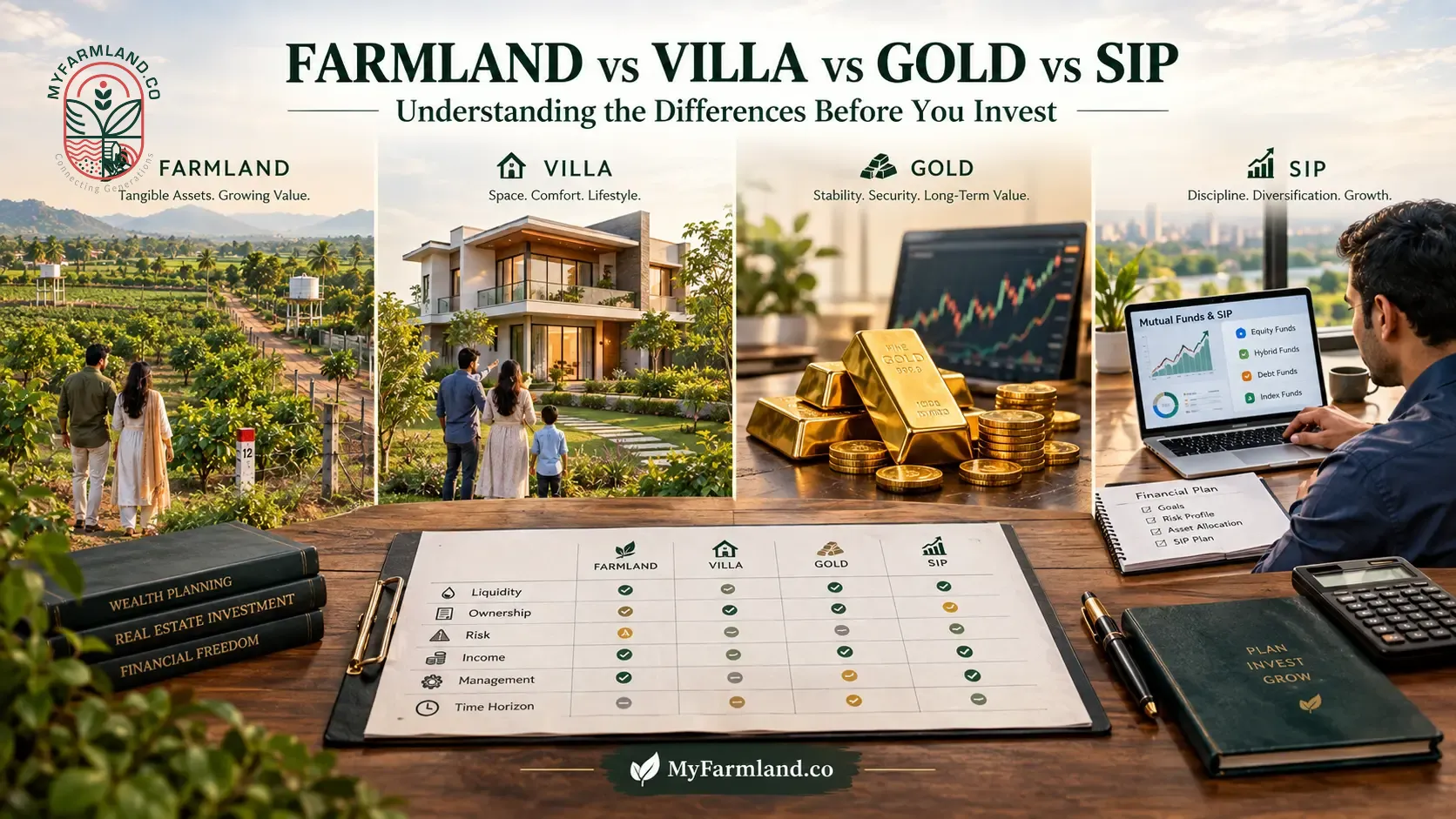
Because these assets have different characteristics, there is no universal answer about which one is “best.” The right comparison depends on the buyer's objective, investment horizon, liquidity needs, risk tolerance, cash flow requirements and willingness to manage a physical asset.
This guide provides a neutral side-by-side comparison to help buyers understand the differences.
Farmland vs Villa vs Gold vs SIP — Quick Comparison
| Factor | Farmland | Villa | Gold | SIP |
|---|---|---|---|---|
| Asset type | Land | Land + building | Precious metal/financial gold | Investment method |
| Physical ownership | Yes | Yes | Depending on form | No physical asset necessarily |
| Starting investment | Varies significantly | Usually high | Can start relatively small | Can start relatively small |
| Liquidity | Generally lower | Generally lower | Generally higher | Depends on underlying fund |
| Regular maintenance | May apply | Usually significant | Usually low for financial forms | No property maintenance |
| Potential income | Agriculture/other permitted uses | Rent | Usually no operating income | Depends on investment |
| Management required | Can be significant | Can be significant | Low | Low |
| Legal due diligence | High | High | Different type | Financial/KYC/fund due diligence |
| Location dependence | Very high | Very high | Relatively low | Depends on underlying investment |
| Price volatility | Market/location dependent | Market/location dependent | Market dependent | Market dependent |
| Exit process | Property transaction | Property transaction | Usually easier | Redemption/sale subject to product |
| Suitable horizon | Often long term | Often medium/long term | Depends on objective | Often used for long-term investing |
Important: The table describes general characteristics, not expected returns.
1. What Is Farmland as an Investment?
Farmland is a physical land asset that can potentially be used for agricultural purposes subject to applicable laws and land-use restrictions.
A farmland owner may potentially benefit from:
- Long-term land ownership
- Agricultural activity
- Plantation
- Farm-related use where legally permitted
- Appreciation in land value
- Rural or lifestyle use where legally permitted
But farmland also requires greater due diligence than many financial assets.
A buyer should examine:
- Ownership
- Title history
- RTC/Pahani
- Encumbrance Certificate
- Mutation
- Survey number
- Land classification
- Access
- Water
- Applicable conversion requirements
- Local restrictions
- Development status
Key characteristic
Farmland is highly location-dependent and relatively illiquid.
A property's future value can be influenced by connectivity, surrounding development, infrastructure, water availability, local demand and the property's legal characteristics.
2. What Is a Villa as an Investment?
A villa is both a residential property and a physical asset.
Unlike farmland, a villa is generally purchased primarily for residential use, subject to applicable approvals and regulations.
Potential objectives include:
- Personal residence
- Weekend home
- Rental income
- Long-term ownership
- Potential appreciation
However, a villa has an additional component that farmland does not necessarily have:
The building itself.
Buildings require maintenance and can depreciate physically over time.
Villa ownership may involve:
- Property tax
- Maintenance
- Repairs
- Utilities
- Community charges
- Insurance
- Renovation
- Security
The location of the villa is also important because residential demand, infrastructure, employment centres, schools and transport can influence its usability and market demand.
3. What Is Gold as an Investment?
Gold is fundamentally different from farmland and villas.
An investor can hold gold in forms such as:
- Physical gold
- Gold ETFs
- Sovereign/other government-linked gold products when available
- Other regulated financial forms of gold exposure
The characteristics differ between these forms.
For example, physical gold involves storage and security considerations, while exchange-traded products involve financial-market and product-specific considerations.
Gold does not generally provide agricultural or residential use.
Its appeal is instead connected to its role as a globally traded precious metal and portfolio asset.
4. What Is an SIP?
One important clarification:
An SIP is not itself an asset class.
SIP stands for Systematic Investment Plan.
It is a method of investing a fixed amount periodically into a mutual fund or other eligible investment product, depending on the platform and product.
For example, an investor might invest ₹10,000 every month rather than investing ₹1.2 lakh at one time.
The underlying mutual fund may invest in:
- Equity
- Debt
- Hybrid securities
- Other permitted instruments
Therefore, the risk and return characteristics of an SIP depend largely on the underlying investment.
An equity mutual fund SIP and a debt mutual fund SIP are not equivalent.
Farmland vs Villa
Farmland and villas are both physical property assets, but their purposes can be very different.
| Factor | Farmland | Villa |
|---|---|---|
| Primary purpose | Agriculture/land ownership | Residential use |
| Building | May not exist or may be restricted | Usually central to the purchase |
| Agriculture | Possible | Generally not the primary purpose |
| Maintenance | Farm/land maintenance | Building + property maintenance |
| Location | Rural/peripheral areas often | Residential locations |
| Water importance | Very high | Important |
| Construction rules | Need careful verification | Usually defined by project approvals |
| Rental potential | Depends on permitted use | More established residential rental market |
| Land component | Dominant | Land + structure |
A buyer interested in farming or rural land ownership may evaluate farmland differently from someone looking primarily for a residence.
Farmland vs Gold
This is an even more fundamental difference.
Farmland
- Physical land
- Location-specific
- Lower liquidity
- Legal due diligence required
- May have agricultural activity
- Maintenance may apply
- Potentially difficult to divide or sell quickly
Gold
- Highly standardized commodity
- More liquid in many forms
- No agricultural management
- No physical location dependency in the same way
- Price influenced by global and domestic markets
Gold does not provide land ownership.
Farmland does not provide the same liquidity and portability associated with many forms of gold investment.
Farmland vs SIP
These are not directly equivalent investments.
Farmland is a physical asset.
An SIP is an investment mechanism.
Suppose an investor has ₹25 lakh available.
They could potentially:
- Buy a farmland parcel
- Use the money toward a villa
- Allocate money toward gold
- Invest periodically or through other methods into mutual funds
Each option creates a different ownership and risk structure.
A financial investment can generally be monitored through account statements and market values.
A farmland investment requires physical and legal verification.
Which Has Higher Liquidity?
Liquidity means how easily an asset can be converted into cash without a significant delay or transaction difficulty.
Generally:
Financial investments and many forms of gold → easier to transact
Physical property → generally slower
But even within each category, liquidity varies.
A highly demanded property in a good location may sell faster than another property.
Similarly, different financial products have different redemption rules.
Therefore, buyers should not assume that every gold investment or every SIP has exactly the same liquidity.
Which Requires More Due Diligence?
Physical land generally requires extensive property-specific due diligence.
For farmland, check:
Legal
- Title
- Sale deed
- Previous documents
- RTC/Pahani
- EC
- Mutation
- Survey
- Land classification
- Access
- Restrictions
Physical
- Boundary
- Soil
- Water
- Roads
- Electricity
- Drainage
- Surrounding development
Commercial
- Purchase price
- Registration costs
- Maintenance
- Management fees
- Development charges
- Resale process
A financial investment requires a different type of due diligence, including understanding the product, underlying assets, costs, risks and applicable disclosures.
What About Regular Income?
This is another major difference.
Farmland
Potential agricultural income may come from:
- Crops
- Fruit
- Plantation
- Timber where legally and practically applicable
- Other agricultural activities
But income depends on production, market prices, costs, weather, water and management.
Villa
A villa may potentially generate:
- Long-term rental income
- Short-term rental income where legally permitted
- Other permitted uses
Again, income is not guaranteed.
Gold
Gold generally does not produce operating income simply from being held.
SIP
An SIP into a mutual fund does not automatically mean regular income. Returns depend on the underlying investment and market performance.
What About Appreciation?
All four can experience changes in value, but the drivers are different.
Farmland
Potential value drivers include:
- Connectivity
- Infrastructure
- Nearby development
- Agricultural productivity
- Local land demand
- Water
- Accessibility
- Legal characteristics
Villa
Potential drivers include:
- Location
- Residential demand
- Employment centres
- Infrastructure
- Quality of construction
- Age of property
- Community development
Gold
Price can be influenced by:
- Global gold prices
- Currency movements
- Interest rates
- Investor demand
- Geopolitical and macroeconomic conditions
SIP
Performance depends on the underlying fund.
An equity mutual fund, for example, is influenced by the performance of the securities it owns.
A Major Difference: Management
Consider the amount of involvement required.
Farmland
Potentially requires:
- Farm management
- Irrigation
- Plantation maintenance
- Security
- Boundary maintenance
- Agricultural planning
A managed farmland project may outsource some of these responsibilities.
Villa
May require:
- Building maintenance
- Repairs
- Landscaping
- Security
- Community maintenance
Gold
Usually minimal ongoing management.
SIP
Generally low day-to-day management after selecting the investment, although investors should periodically review whether the investment remains appropriate for their objectives.
What If You Want a Weekend Lifestyle?
This changes the comparison.
Someone looking for:
- Green surroundings
- Farming
- Trees
- Outdoor space
- Rural experience
- Family weekends
- Agricultural activity
may investigate farmland.
Someone looking for:
- Bedrooms
- Kitchen
- Urban connectivity
- Residential amenities
- Ready-to-use accommodation
may investigate a villa.
Gold and SIPs do not provide this lifestyle component.
What If You Want Liquidity?
If easy access to money is a major requirement, physical property may need to be evaluated differently from financial assets.
A farmland owner may need to:
- Find a buyer
- Negotiate a price
- Complete legal verification
- Complete documentation
- Complete registration/transaction formalities
This can take time.
Financial products may provide different exit mechanisms, depending on the product.
Therefore, an investor should consider:
How quickly might I need this money?
before committing a substantial amount to a physical property.
What If You Have a ₹25 Lakh Budget?
Instead of asking which asset is universally better, first define the objective.
Objective A — Land Ownership
Farmland may be relevant for investigation.
Objective B — Residential Living
A villa or other residential property may be more directly aligned.
Objective C — Portfolio Exposure
Gold or financial investments may be considered.
Objective D — Agricultural Lifestyle
Farmland may be relevant.
Objective E — Long-Term Financial Investment
The comparison should include liquidity, diversification, risk, taxation, costs and time horizon.
The same ₹25 lakh can therefore lead to very different decisions depending on the purpose.
A Practical Decision Framework
Ask these eight questions before choosing an asset:
1. Why am I investing?
- Land ownership?
- Residence?
- Agriculture?
- Wealth accumulation?
- Diversification?
- Lifestyle?
2. How long can I hold it?
- 1–3 years
- 3–5 years
- 5–10 years
- 10+ years
3. How much liquidity do I need?
If you may need the money quickly, physical property requires careful consideration.
4. Do I want a physical asset?
Farmland, villas and physical gold provide different forms of tangible ownership.
5. How much management can I handle?
Farmland and villas can require more involvement than many financial assets.
6. Do I need regular income?
Your evaluation should distinguish potential income from guaranteed income.
7. What level of risk can I accept?
Every asset has different risks.
8. Have I diversified?
Putting all available capital into one asset can create concentration risk.
Farmland Buyer Checklist
If farmland is under consideration, complete these checks before purchasing:
- Verify ownership
- Review title chain
- Check RTC/Pahani
- Check EC
- Verify mutation
- Confirm survey number
- Conduct physical survey
- Verify access
- Check land classification
- Understand applicable conversion rules
- Verify water
- Check electricity
- Calculate registration costs
- Calculate annual maintenance
- Understand construction rules
- Review management agreement
- Check resale process
- Get independent legal advice
Farmland vs Villa vs Gold vs SIP: Questions to Ask
| Question | Farmland | Villa | Gold | SIP |
|---|---|---|---|---|
| Do I want land? | Yes | Yes | No | No |
| Do I want a home? | Not necessarily | Yes | No | No |
| Do I want farming? | Potentially | Usually no | No | No |
| Do I need high liquidity? | Usually less liquid | Usually less liquid | Depends on form | Depends on fund |
| Am I comfortable with property paperwork? | Yes | Yes | Different | Financial paperwork |
| Can I handle maintenance? | May be required | Usually required | Usually low | Usually low |
| Do I understand the underlying asset? | Land | Property | Gold | Fund/underlying securities |
| Do I need professional advice? | Often useful | Often useful | Product dependent | Product dependent |
Common Mistakes When Comparing Assets
Mistake 1: Comparing Only Historical Returns
Past performance does not guarantee future results.
Mistake 2: Ignoring Liquidity
An asset's value is not the same thing as how quickly you can sell it.
Mistake 3: Ignoring Costs
Include:
- Transaction costs
- Maintenance
- Taxes
- Management fees
- Fund expenses
- Storage/security costs where applicable
Mistake 4: Comparing SIP With a Specific Asset
Remember:
SIP = investment method
not a specific asset.
Mistake 5: Assuming Appreciation Is Guaranteed
No asset should be evaluated on the assumption that its price must rise.
Frequently Asked Questions
Is farmland better than a villa?
Farmland and villas serve different purposes. Farmland is primarily associated with land and agricultural use, while a villa is primarily residential. The relevant choice depends on the buyer's objectives.
Is farmland better than gold?
They are fundamentally different assets. Farmland provides physical land ownership and may support agricultural activity, while gold provides exposure to a precious metal. Liquidity, management and risk characteristics also differ.
Is farmland better than an SIP?
An SIP is a method of investing rather than a standalone asset class. A comparison should consider the specific mutual fund or investment product underlying the SIP.
Can farmland generate income?
Agricultural land may generate income from permitted agricultural activities, but income depends on crops, yields, costs, weather, water and market conditions.
Is farmland a liquid investment?
Farmland is generally less liquid than many financial investments because selling physical property requires finding a buyer and completing property transaction formalities.
Should I invest all my savings in farmland?
Asset allocation should depend on your financial situation, liquidity requirements, risk tolerance, time horizon and diversification needs. A physical property should not be evaluated in isolation from your broader financial position.
Final Thoughts
Farmland, villas, gold and SIPs are not interchangeable products.
They represent different combinations of:
Ownership + Liquidity + Risk + Management + Income Potential + Lifestyle + Time Horizon
Farmland may appeal to someone who specifically wants land and an agricultural environment.
A villa may suit someone prioritizing residential use.
Gold may provide exposure to a precious metal.
An SIP provides a systematic way to invest in an underlying financial product.
The important question is therefore not:
“Which asset is the best?”
Instead ask:
“Which asset matches my objective, time horizon, liquidity needs, risk tolerance and willingness to manage it?”
For anyone considering farmland, the next step should be property-level due diligence rather than relying solely on a general asset comparison.
Suggested Internal Links
Link this article to the previous MyFarmland.co articles:
- What Is Managed Farmland? Complete Guide for First-Time Buyers
- 15 Farmland Buying Mistakes to Avoid in India
- How to Verify Farmland Before Buying
- Farmland Buying Checklist: 15 Documents to Check Before Buying
- Farmland Investment in Karnataka: 10 Things Buyers Must Know
- Farmland vs Urban Plots: Investment Comparison
- How Much Does Farmland Cost Near Bangalore in 2026?
- 10 Best Farmland Locations Near Bangalore in 2026
Recommended anchor text
- managed farmland guide
- farmland buying mistakes
- farmland due diligence
- farmland buying checklist
- farmland investment in Karnataka
- farmland near Bangalore
- farmland price near Bangalore
Villa vs Gold vs SIP: Investment Comparison 2026 Farmland vs villa vs gold vs SIP: compare liquidity, ownership, income potential, management, risks, costs and suitability before investing in 2026. farmland vs villa vs gold vs SIP
Legal & Financial Disclaimer
This article is for general educational purposes only and is not financial, investment, tax or legal advice. Investment products have different risks, costs, taxation and liquidity characteristics. Mutual fund investments are subject to market risks, and past performance does not guarantee future results. Property laws and land-use requirements vary by location and property type. Readers should conduct independent due diligence and consult appropriately qualified financial and legal professionals before making investment or property decisions.