
Farmland vs Urban Plots: Which Is Better for Investment in 2026?
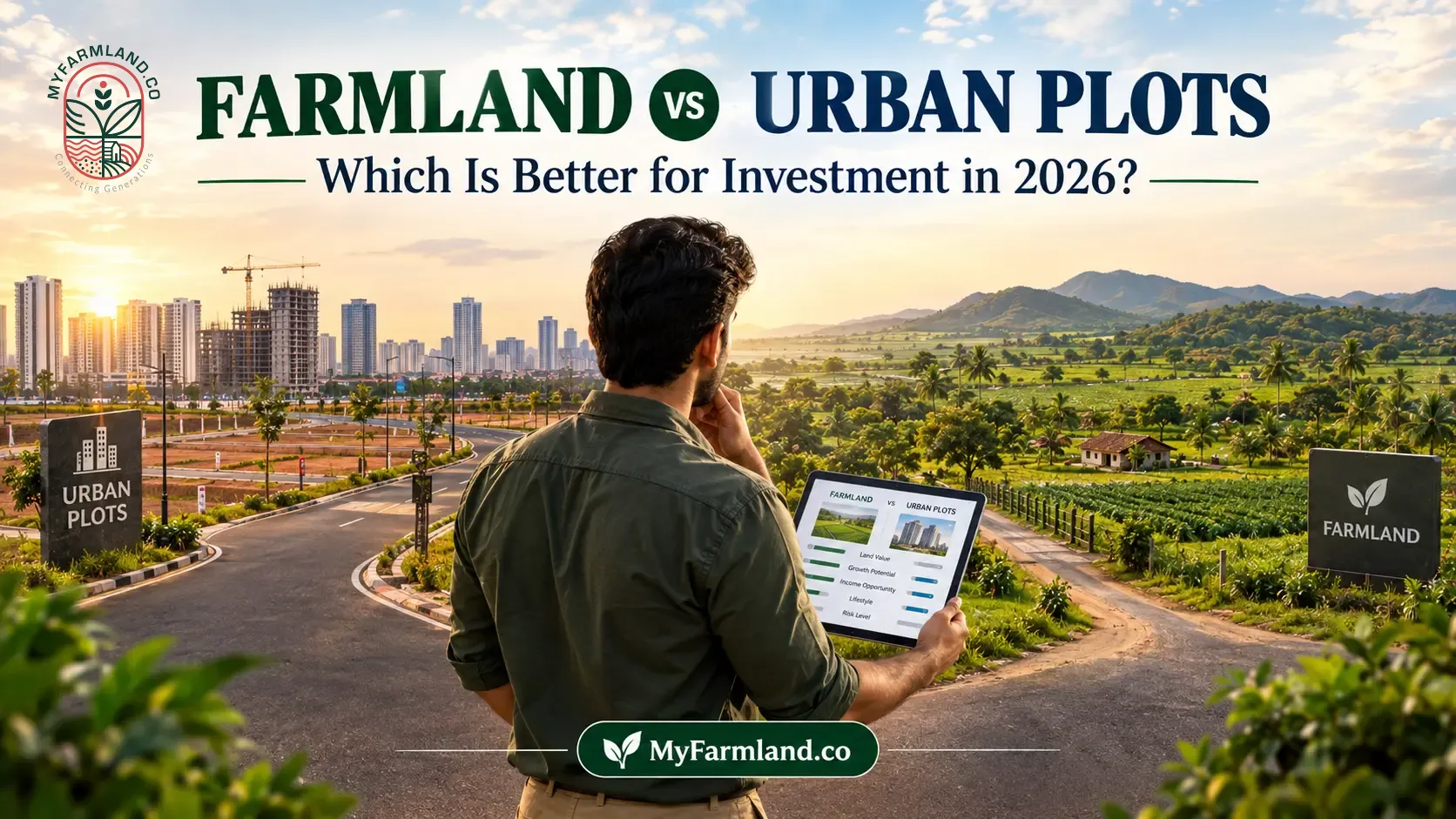
Farmland vs Urban Plots: Which Is Better for Investment in 2026?
When people think about buying land, two options often come up:
Farmland or an urban residential plot?
Both can be attractive investments, but they serve very different purposes.
An urban plot may appeal to buyers who want proximity to established infrastructure and future construction potential. Farmland, on the other hand, can offer a combination of land ownership, agriculture, nature, recreation and, in some managed projects, additional farm-related or hospitality opportunities.
The right choice depends on your budget, investment horizon, intended use, location and risk tolerance.
Instead of asking which one is universally better, investors should ask:
Which type of land better matches my objective?
Let's compare them.
1. What Is an Urban Residential Plot?
An urban residential plot is generally land located within a developed or developing residential area where applicable planning and approvals permit residential development.
These plots may benefit from:
- Existing roads
- Nearby residential communities
- Schools and hospitals
- Commercial developments
- Public transport
- Employment hubs
- Infrastructure expansion
- Potential future construction
The investment thesis is usually straightforward:
Buy land → hold → benefit from appreciation and/or build a property.
However, the actual development potential depends on the property's title, zoning, approvals, road access and applicable local regulations.
2. What Is Farmland?
Farmland is agricultural land intended primarily for agricultural use, subject to the laws and land-use regulations applicable to that location.
A farmland investment may involve:
- Agricultural cultivation
- Plantation
- Orchards
- Weekend use, where legally permitted
- Farm-related activities
- Long-term land holding
- Managed farming
- Farmstay or hospitality components where appropriately approved
One important point:
Farmland should not automatically be treated as residential land.
Buyers should verify what activities are legally permitted on the specific property before purchasing.
3. Farmland vs Urban Plots: Quick Comparison
| Factor | Farmland | Urban Plot |
|---|---|---|
| Primary purpose | Agriculture | Residential/commercial development as permitted |
| Typical surroundings | Rural/natural | Urban/semi-urban |
| Entry price | Can vary significantly by location | Often higher in established areas |
| Infrastructure | May be developing | Usually more developed |
| Appreciation | Highly location dependent | Highly location dependent |
| Construction | Subject to agricultural land-use rules | Subject to zoning and approvals |
| Maintenance | Agriculture/land management may be required | Usually lower until development |
| Recreation | Often stronger | Usually limited |
| Agricultural activity | Possible | Generally not the primary purpose |
| Development potential | Requires careful legal verification | Depends on zoning and approvals |
| Liquidity | Location dependent | Location dependent |
| Due diligence | Very important | Very important |
There is no automatic winner.
Location matters more than the label.
4. Why Investors Consider Farmland
One reason farmland attracts investors is that it combines land ownership with a different lifestyle proposition.
Instead of purchasing only a piece of land, some managed farmland communities may provide infrastructure and agricultural management around the property.
Depending on the project, this can include:
- Internal roads
- Fencing
- Water infrastructure
- Plantation
- Security
- Common amenities
- Farm management
- Recreational spaces
However, these features vary from project to project and should never be assumed.
Always verify what is actually included in the agreement.
5. Why Investors Consider Urban Plots
Urban plots have a different advantage.
They are generally purchased with the expectation that urbanisation and infrastructure growth may increase the value of the property.
For example, investors may look at:
- New highways
- Metro or rail connectivity
- Industrial corridors
- Employment centres
- IT parks
- Airports
- New residential developments
- Commercial activity
A plot surrounded by genuine development can potentially become more valuable over time.
But investors should distinguish between announced infrastructure and completed infrastructure.
Don't invest purely because someone says:
"A highway is coming here."
Verify the project, alignment, status and impact independently.
6. Farmland Investment Is About Location
Not all farmland is a good investment.
The same principle applies to urban plots.
A farmland parcel with poor road access, unclear title and limited demand may be a weak investment.
Meanwhile, farmland located near a growing economic corridor with strong connectivity, water availability and clear documentation may attract significantly more interest.
Before buying, evaluate:
Connectivity
How easily can you reach the property?
Nearby cities
What population centres are within reasonable driving distance?
Infrastructure
Are roads and utilities actually available?
Water
What is the current and sustainable water source?
Land quality
Is the land suitable for the proposed agricultural activity?
Surrounding development
What is actually happening around the property?
Exit market
Who is likely to buy the property from you later?
7. Don't Compare Only the Price Per Square Foot
This is one of the biggest mistakes investors make.
An urban plot may cost more per square foot than farmland.
That doesn't automatically mean the urban plot is better.
Similarly, cheaper farmland isn't automatically a better investment.
Compare the total value proposition.
Look at:
Purchase price + development costs + maintenance + taxes + legal costs + infrastructure + expected holding period + exit demand
For farmland, also consider agricultural management and any project-specific recurring expenses.
For urban plots, consider development charges and eventual construction costs if you plan to build.
8. What About Income?
This is where investors need to be particularly careful.
Land itself does not automatically generate income.
Farmland can potentially support income-producing activities such as:
- Agriculture
- Orchards
- Plantation
- Farm-related experiences
- Farmstay/hospitality operations where legally permitted
But these are not guaranteed returns.
If a project advertises rental income, farm income or guaranteed appreciation, ask:
What is the legal and contractual basis for that claim?
Understand who operates the activity, what expenses are deducted and what happens if occupancy or agricultural yields are lower than expected.
9. Farmland vs Urban Plot: Which Has Better Appreciation?
There is no universal answer.
Appreciation depends on:
Location + demand + infrastructure + legal status + supply + accessibility + market cycle
An urban plot in a stagnant location can underperform.
Farmland near a rapidly developing corridor can perform strongly.
At the same time, agricultural land in a remote location with weak demand may remain difficult to sell.
Therefore, don't ask:
"Does farmland appreciate faster?"
Ask:
"What is driving demand in this particular location?"
That is a much better investment question.
10. The Importance of the Exit Strategy
Before buying any land, think about how you will eventually sell it.
Ask:
- Who will buy this property from me?
- What type of buyer is likely to be interested?
- Is the property easy to access?
- Are the documents clean?
- Is the land legally transferable?
- Is there genuine demand in the surrounding area?
- What could make the property more attractive five years from now?
A beautiful property without an exit market can become a difficult investment.
11. Managed Farmland vs Traditional Farmland
Traditional farmland usually requires the owner to take responsibility for agricultural operations, maintenance and management.
A managed farmland project may provide additional services such as:
- Plantation management
- Farm maintenance
- Security
- Internal infrastructure
- Common amenities
- Agricultural support
This can make ownership more convenient.
But convenience may come with:
- Development/maintenance charges
- Management fees
- Rules and restrictions
- Service agreements
Therefore, buyers should read the agreement carefully rather than relying only on marketing material.
12. Legal Due Diligence Is Non-Negotiable
Whether you purchase farmland or an urban plot, legal verification should happen before paying a significant advance.
For farmland, pay particular attention to:
- Title deed
- Parent documents
- Encumbrance Certificate
- RTC/Pahani
- Mutation records
- Survey number
- Subdivision records
- Land classification
- Access road
- Conversion/diversion requirements, if applicable
- Litigation
- Acquisition notifications
- Applicable restrictions
- Seller identity and ownership
For urban plots, verify the applicable:
- Layout approval
- Land-use/zoning
- Title
- Encumbrances
- Conversion
- Planning authority approvals
- Khata/property records
- Development permissions
The exact documents and approvals depend on the state and location.
13. Five Questions to Ask Before Buying Farmland
1. Is the title clear?
Don't rely only on the seller's statement.
2. Is there legal access?
A property without reliable legal access can create serious problems later.
3. What is the permitted land use?
Never assume agricultural land can automatically be converted into a farmhouse, resort or residential property.
4. What exactly am I buying?
Understand the survey number, extent, boundaries and your ownership rights.
5. Who will buy it from me later?
Your exit strategy should be considered before your entry.
14. Five Questions to Ask Before Buying an Urban Plot
Ask:
- Is the layout legally approved?
- Is the title clear?
- Is the land-use classification appropriate?
- Are roads and infrastructure actually available?
- What developments are genuinely happening nearby?
Don't confuse a marketing promise with an approval.
15. Which Is Better for You?
Choose farmland if your priority is:
- Long-term land ownership
- Nature and open space
- Agricultural activity
- Plantation
- Weekend lifestyle
- Managed farming, where offered
- Diversifying your real-estate portfolio
Consider an urban plot if your priority is:
- Urban connectivity
- Future construction
- Proximity to established infrastructure
- Residential development potential
- Exposure to urban expansion
But in both cases:
The specific property matters more than the category.
16. The Smart Investor's Approach
Instead of deciding:
Farmland vs Urban Plot
Use this framework:
Step 1 — Define your goal
Investment? Agriculture? Weekend use? Future construction? Income?
Step 2 — Fix your holding period
Are you investing for 3 years, 5 years, 10 years or longer?
Step 3 — Research the location
Study infrastructure, employment, population growth and actual development.
Step 4 — Verify the documents
Get independent legal due diligence.
Step 5 — Visit the property
Never make a land investment decision based entirely on photographs or a presentation.
Step 6 — Calculate the complete cost
Include registration, development, maintenance and other applicable expenses.
Step 7 — Plan the exit
Know your likely future buyer.
Final Verdict
Farmland is not automatically better than an urban plot, and an urban plot is not automatically better than farmland.
The better investment is the property with:
Clear title + appropriate land use + strong location fundamentals + genuine demand + good accessibility + realistic pricing + a clear exit strategy.
For investors considering farmland, the most important lesson is simple:
Don't buy farmland because it is cheap. Buy it because the land, location, documentation and long-term demand make sense.
And don't evaluate an urban plot only because it is inside a city.
Good land is good land—but good investment decisions come from due diligence.
Farmland Investment Checklist
Before you invest, make sure you have verified:
☐ Ownership and title ☐ Parent documents ☐ EC ☐ RTC/Pahani ☐ Mutation ☐ Survey boundaries ☐ Legal access ☐ Land classification ☐ Applicable conversion requirements ☐ Water availability ☐ Surrounding development ☐ Project approvals, where applicable ☐ Agreement terms ☐ Total investment cost ☐ Exit strategy
Disclaimer
This article is for general educational and informational purposes only. Land laws, zoning rules, conversion requirements, registration procedures and property restrictions vary by state and location and may change over time. Buyers should obtain independent legal, technical and financial advice and verify the latest records with the relevant authorities before purchasing any property.