
Farmland Investment vs Fixed Deposit: Which Is Better for Long-Term Wealth in 2026? | MyFarmland.co
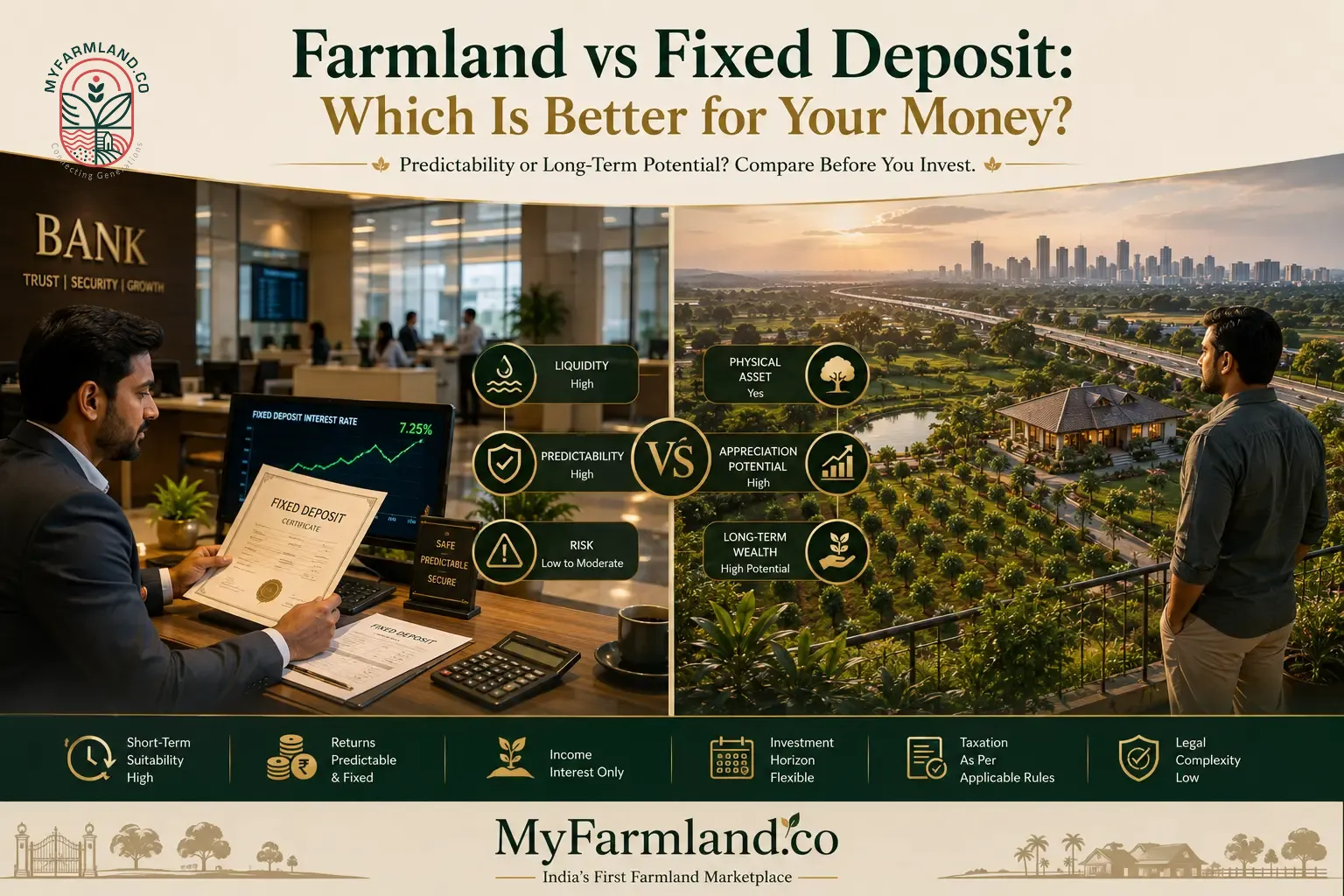
When people think about safe investments, fixed deposits are often one of the first options that come to mind.
But a growing number of investors are also exploring farmland as a long-term real asset.
This raises an important question:
Should you keep your money in a fixed deposit or invest in farmland?
The two investments are fundamentally different.
A fixed deposit is primarily designed for predictable interest income and capital preservation.
Farmland is a physical asset whose value can be influenced by location, agricultural productivity, infrastructure, demand, and land scarcity.
There is no universal winner.
The better choice depends on your investment objective, risk tolerance, liquidity requirements, and investment horizon.
What Is a Fixed Deposit?
A fixed deposit allows an investor to place money with a bank or financial institution for a predetermined period at an agreed interest rate.
The main attraction is predictability.
Investors generally know:
- How much they are investing
- The tenure
- The applicable interest rate
- The maturity structure
This makes FDs suitable for investors who prioritize simplicity and relatively predictable returns.
What Is Farmland Investment?
Farmland investment involves purchasing agricultural land for purposes such as:
- Agricultural use
- Plantation
- Long-term land ownership
- Lifestyle use, where legally permitted
- Managed farmland participation
The value of farmland can change over time depending on location and market conditions.
Unlike an FD, farmland does not provide a predetermined return.
Farmland vs Fixed Deposit: Quick Comparison
| Factor | Farmland | Fixed Deposit |
|---|---|---|
| Asset Type | Physical land | Financial deposit |
| Return | Not guaranteed | Interest rate predetermined under deposit terms |
| Liquidity | Generally lower | Generally higher, subject to bank terms |
| Appreciation Potential | Possible | No direct asset appreciation |
| Management | May require maintenance | Minimal |
| Inflation Exposure | Physical asset | Interest may or may not outpace inflation |
| Income | Agriculture/rent where applicable | Interest |
| Legal Due Diligence | Essential | Comparatively simple |
| Investment Horizon | Often long-term | Flexible tenure |
| Location Impact | Very high | Not applicable |
1. The Biggest Difference: Physical Asset vs Financial Product
A farmland investor owns a tangible asset.
You can:
- Visit it
- Cultivate it
- Plant trees
- Use it for agriculture
- Hold it for the long term
An FD is different.
Your investment is a financial claim against the bank under the deposit terms.
This difference is important when building a diversified portfolio.
2. Farmland Has Location-Driven Potential
A major factor influencing farmland value is location.
Consider land near:
- Highways
- Industrial corridors
- Technology hubs
- Airports
- Major cities
- Tourism destinations
As accessibility and economic activity develop, market interest in surrounding land may change.
However, infrastructure does not automatically guarantee appreciation.
3. Farmland Has No Guaranteed Return
This is critical.
A farmland seller should not promise that your land will definitely double, triple, or generate a specific return.
Land prices depend on:
- Demand
- Supply
- Location
- Infrastructure
- Economic conditions
- Legal status
- Land usability
Therefore, farmland should be evaluated as a long-term real asset, not a guaranteed-return product.
4. FDs Offer Greater Predictability
One major advantage of fixed deposits is predictability.
You can generally determine the interest rate applicable to the deposit at the time of investment.
This makes FDs useful for:
- Emergency funds
- Short-term goals
- Capital preservation
- Predictable income planning
Always check the applicable bank terms, taxation, premature withdrawal conditions, and deposit insurance rules.
5. Liquidity Is an Important Difference
If you need your money quickly, an FD is generally easier to access than farmland.
Selling farmland may require:
- Finding a buyer
- Negotiating a price
- Completing due diligence
- Documentation
- Registration
The time required can vary considerably.
Therefore, farmland should generally be considered with a longer investment horizon.
6. Farmland Can Provide Multiple Uses
Unlike an FD, farmland can potentially serve multiple purposes.
Depending on local laws and the property's characteristics, it may be used for:
- Farming
- Orchards
- Plantation
- Agroforestry
- Farm-related activities
Some properties may also have lifestyle applications where legally permitted.
This gives physical land a degree of utility that a financial deposit does not provide.
7. Inflation Is Another Factor
Inflation reduces the purchasing power of money over time.
Investors therefore often look for assets that can potentially maintain or increase their value over longer periods.
Land is a physical asset, and its market value may rise over time.
But this is not automatic.
A poorly located or legally problematic property can perform poorly regardless of broader land-market trends.
8. The Hidden Cost of Farmland
Farmland ownership isn't completely passive.
Depending on the property, you may have expenses related to:
- Maintenance
- Security
- Irrigation
- Plantation
- Fencing
- Property taxes
- Management fees
Managed farmland may reduce some of the operational burden, but investors should carefully understand recurring charges before purchasing.
9. The Hidden Cost of FDs
FD returns can also be affected by:
- Income tax
- Inflation
- Premature withdrawal conditions
- Changes in prevailing interest rates when reinvesting at maturity
The headline interest rate should therefore not be the only factor considered.
Which One Is Safer?
The word "safe" means different things to different investors.
If safety means:
Predictable interest and easier liquidity, an FD may be more appropriate.
If safety means:
Owning a tangible asset for the long term, farmland may appeal to some investors—but it comes with market, legal, liquidity, and management risks.
Neither should be treated as completely risk-free.
Who Should Consider Farmland?
Farmland may be worth considering if you:
- Have a long investment horizon
- Want exposure to physical assets
- Understand land-related risks
- Don't require immediate liquidity
- Want agricultural or lifestyle utility
- Are comfortable conducting detailed due diligence
Who May Prefer Fixed Deposits?
FDs may be more suitable if you:
- Prioritize liquidity
- Want predictable interest
- Have short- or medium-term financial goals
- Don't want property-management responsibilities
- Prefer simpler investments
A Smarter Approach: Don't Think Only in "Either/Or"
Investors don't necessarily have to choose one asset class exclusively.
A diversified financial strategy may include:
- Bank deposits
- Equity investments
- Bonds
- Gold
- Real estate
- Farmland
The appropriate allocation depends on individual circumstances and financial goals.
What to Check Before Buying Farmland
If you decide to explore farmland, don't begin with the price.
Begin with due diligence.
Legal
Check:
- Title deed
- Ownership history
- Encumbrance Certificate
- Revenue records
- Survey details
Physical
Check:
- Water
- Soil
- Road access
- Electricity
- Boundaries
Location
Study:
- Existing infrastructure
- Future infrastructure
- Employment hubs
- Population growth
- Nearby development
Investment
Ask:
- Who will buy this land in the future?
- What is the realistic holding period?
- What are the recurring costs?
- Is there an exit strategy?
Why MyFarmland.co?
Choosing farmland requires more than browsing property advertisements.
At MyFarmland.co, our goal is to help buyers explore farmland opportunities while understanding important investment factors such as:
- Location
- Legal verification
- Connectivity
- Water availability
- Project infrastructure
- Long-term potential
Explore farmland opportunities and educational resources at:
Final Verdict: Farmland or Fixed Deposit?
There is no universal answer.
Choose an FD if your priority is:
Predictability + Liquidity + Simplicity
Consider farmland if your priority is:
Physical ownership + Long-term potential + Agricultural/Lifestyle utility
The smartest decision isn't necessarily choosing the investment with the highest advertised return.
It's choosing an investment that matches your financial goals, time horizon, liquidity needs, and risk tolerance.
And if you choose farmland, remember:
The land you buy matters more than the story you're told about it.
Frequently Asked Questions
Is farmland better than an FD?
Not universally. Farmland and FDs have different risk, liquidity, return, and ownership characteristics.
Does farmland provide guaranteed returns?
No. Farmland appreciation and agricultural income are not guaranteed.
Is farmland a good long-term investment?
It can be considered as part of a long-term investment strategy, provided the property has strong fundamentals and is legally verified.
Is an FD more liquid than farmland?
Generally yes. FD withdrawals are governed by the bank's terms, while selling farmland requires finding a buyer and completing a property transaction.
What should I check before buying farmland?
Verify title, ownership, encumbrances, survey boundaries, water availability, road access, applicable regulations, and the property's long-term location fundamentals.