
Farmland Investment Exit Strategy: How Will You Sell Your Land in the Future? | MyFarmland.co
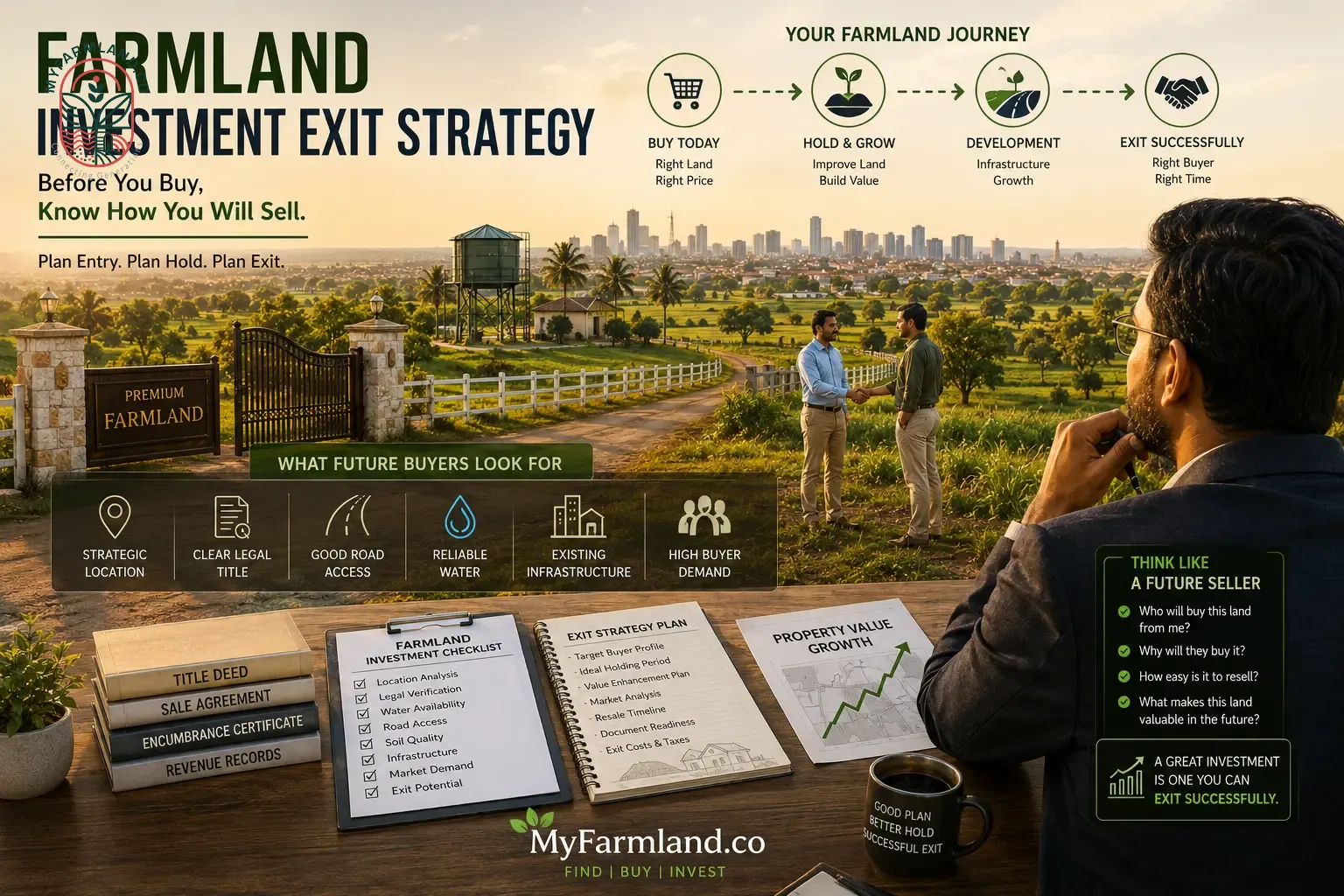
Farmland Investment Exit Strategy: How Will You Sell Your Land in the Future?
Most farmland buyers ask the same questions before purchasing:
What is the price?
How much can the land appreciate?
Where is the property located?
But there is one question that is often ignored:
Who will buy this land from me later?
This is the foundation of an effective farmland investment exit strategy.
Buying land is only one part of an investment.
The other part is being able to sell it when you need to.
Farmland can be a long-term asset, but it is generally less liquid than many financial investments. Therefore, understanding future buyer demand before purchasing can help you make a more informed decision.
What Is a Farmland Exit Strategy?
An exit strategy is your plan for eventually converting your land investment back into cash or transferring ownership.
Your exit could happen after:
- 3 years
- 5 years
- 10 years
- 15 years
- Or a much longer holding period
The important point is to think about the exit before buying, not after.
Why Farmland Liquidity Matters
Unlike buying a listed financial asset, selling farmland usually requires finding a suitable buyer and completing a property transaction.
The process may involve:
- Marketing the property
- Finding buyers
- Negotiating the price
- Legal verification
- Documentation
- Registration
The actual time required can vary significantly depending on the property and market conditions.
That's why marketability matters almost as much as price.
The 7 Factors That Can Improve Farmland Resale Potential
1. Location
Location is one of the most important factors influencing future buyer interest.
A property with good connectivity to a major city can potentially appeal to a wider pool of buyers.
Look for:
- Highways
- Good roads
- Nearby cities
- Employment hubs
- Industrial corridors
- Airports
- Tourism destinations
However, don't buy solely because a future project has been announced.
Verify the project's actual status.
2. Legal Clarity
Imagine finding a buyer after five years.
They are interested.
They have the money.
Then their lawyer discovers documentation problems.
The transaction can become complicated or collapse entirely.
That's why maintaining clear documentation from the beginning is critical.
Keep records related to:
- Title
- Sale deed
- Encumbrance records
- Revenue documents
- Survey details
- Tax payments
- Other applicable property records
A legally clean property is easier to explain to a future buyer.
3. Road Access
Ask yourself:
Can someone easily reach this property?
Good access can improve usability and buyer interest.
Consider:
- Highway connectivity
- Approach road
- Internal roads
- Road quality
- Legal access
A property that looks excellent on a map but has difficult physical access can have limited marketability.
4. Water Availability
Water isn't just important for agriculture.
It can also influence the attractiveness of farmland to future buyers.
A property with:
- Reliable water
- Irrigation infrastructure
- Borewell
- Storage
- Established plantation
may be more attractive than an otherwise similar property without these features.
For more information, see:
Why Water Is the Most Valuable Asset in Farmland.
5. Property Size
Different buyers want different sizes.
A small plot may appeal to:
- Individual investors
- Families
- Weekend users
A larger agricultural parcel may attract:
- Farmers
- Agricultural businesses
- Developers, where legally permissible
- Plantation operators
Before buying, understand the likely buyer profile for your particular property.
6. Existing Improvements
A piece of raw land and a productive, well-maintained farm are not necessarily perceived the same way by buyers.
Depending on local laws and the property structure, useful improvements may include:
- Mature plantation
- Irrigation
- Fencing
- Farm infrastructure
- Internal roads
- Water storage
- Security systems
But remember:
Don't spend money on improvements simply because you assume they will increase resale value.
The improvement should have genuine utility and comply with applicable regulations.
7. Surrounding Development
Future buyers don't look only at your plot.
They look at the surrounding region.
They may ask:
- What is happening nearby?
- How easy is it to reach?
- Are there good roads?
- Is the area developing?
- Are there employment centers?
- Are there established communities?
A property's surrounding ecosystem can influence future demand.
The Biggest Exit Mistake: Buying for Appreciation Alone
One of the most dangerous assumptions in land investment is:
"I'll buy now and someone will pay much more later."
Maybe.
But there is no guarantee.
A property can appreciate differently from another property only a few kilometres away.
Instead of relying exclusively on appreciation, evaluate:
Location + Legal Clarity + Access + Water + Usability + Demand
These fundamentals can make a property more marketable.
Create Your Future Buyer Profile
Before buying farmland, imagine yourself five years in the future.
Who could be your buyer?
Buyer Type 1: Farmer
They may prioritize:
- Soil
- Water
- Agricultural productivity
- Access
Buyer Type 2: Investor
They may prioritize:
- Location
- Documentation
- Market price
- Future demand
Buyer Type 3: Family Buyer
They may prioritize:
- Accessibility
- Natural surroundings
- Security
- Usability
Buyer Type 4: Plantation Buyer
They may prioritize:
- Existing trees
- Water
- Soil
- Farm infrastructure
If your property can appeal to multiple buyer categories, it may have a broader potential market.
The 10-Year Farmland Exit Test
Before investing, ask yourself these questions:
Year 1
Is the property legally clear?
Year 3
Is the location becoming more accessible?
Year 5
Has surrounding development increased?
Year 7
Would another investor consider buying it?
Year 10
Can I clearly explain why this property is valuable?
If you cannot answer these questions, investigate the investment more carefully.
Don't Ignore Selling Costs
When planning your exit, remember that selling property can involve transaction expenses and tax implications.
Depending on the transaction and your circumstances, consider:
- Brokerage
- Legal expenses
- Documentation
- Applicable taxes
- Registration-related requirements
Consult a qualified tax professional for advice specific to your situation.
How Managed Farmland Can Affect Resale
Managed farmland can offer a different resale proposition because the property may have additional features such as:
- Established plantation
- Maintained landscaping
- Irrigation
- Security
- Internal infrastructure
- Community amenities
But buyers should understand the exact ownership and management structure.
A future buyer should be able to understand:
What exactly am I purchasing?
What services continue after transfer?
What are the recurring fees?
What documents prove ownership?
Clear answers can make the property easier to present to future buyers.
A Simple Farmland Exit Scorecard
Before buying, rate the property from 1 to 5:
| Factor | Score |
|---|---|
| Location | /5 |
| Road Access | /5 |
| Water | /5 |
| Legal Clarity | /5 |
| Soil Quality | /5 |
| Existing Infrastructure | /5 |
| Surrounding Development | /5 |
| Buyer Demand | /5 |
| Property Usability | /5 |
| Documentation | /5 |
This isn't a prediction of future returns.
It is simply a framework for comparing properties more objectively.
What Makes Farmland Difficult to Sell?
Watch for:
- Poor access
- Unclear title
- Documentation problems
- Water scarcity
- Remote location
- Weak buyer demand
- Overpriced land
- Disputed boundaries
- Unclear ownership structure
- Illegal or non-compliant construction
A property may look inexpensive initially but become difficult to sell later.
How to Make Your Farmland More Marketable
If you already own farmland, focus on fundamentals.
Maintain:
- Clean documentation
- Clear boundaries
- Accessible roads
- Proper plantation records
- Water infrastructure records
- Tax and ownership documents
Keep photographs and records of improvements.
When you eventually sell, a well-organized documentation package can make due diligence easier for the buyer.
Why MyFarmland.co?
At MyFarmland.co, we believe farmland investors should think beyond the initial purchase.
Our platform focuses on farmland opportunities and educational resources covering:
- Managed farmland
- Premium farmland
- Farmland investment
- Location analysis
- Legal due diligence
- Infrastructure growth
- Investment strategies
Explore farmland opportunities at:
Final Farmland Exit Checklist
Before buying farmland, ask:
1. Who is my future buyer?
2. Is the property legally clear?
3. Does it have reliable access?
4. Is water available?
5. Is the surrounding area developing?
6. Is the property reasonably priced today?
7. Does the property have genuine agricultural or lifestyle utility?
8. What costs will I face when selling?
9. How long am I prepared to hold it?
10. Would I buy this property again five years from now?
If you can answer these questions confidently, you're thinking beyond the purchase.
You're thinking like an investor.
Conclusion
A successful farmland investment isn't just about finding land at a good price.
It's about buying a property that remains useful, legally clear, accessible and desirable over time.
The best time to create your exit strategy is before you buy.
Don't ask only:
"How much can this land appreciate?"
Ask:
"Why would someone want to buy this land from me in the future?"
That question can completely change how you evaluate farmland.
Buy with an entry strategy.
Hold with a plan.
Exit with clarity.
Frequently Asked Questions
Is farmland easy to resell?
It depends on the location, price, legal status, accessibility, market demand and property characteristics. Farmland is generally less liquid than many financial investments.
How long should I hold farmland?
There is no universal holding period. Your investment horizon should depend on your financial goals, location fundamentals and market conditions.
Does infrastructure guarantee farmland appreciation?
No. Infrastructure can potentially improve accessibility and demand, but appreciation is never guaranteed.
What makes farmland attractive to future buyers?
Factors can include location, legal clarity, water availability, road access, soil quality, existing improvements and surrounding development.
Should I buy farmland only for resale?
Not necessarily. Farmland can also provide agricultural, plantation or lifestyle utility depending on the property and applicable regulations.