
Farmland Buying Checklist: 15 Documents & Checks Before You Pay an Advance
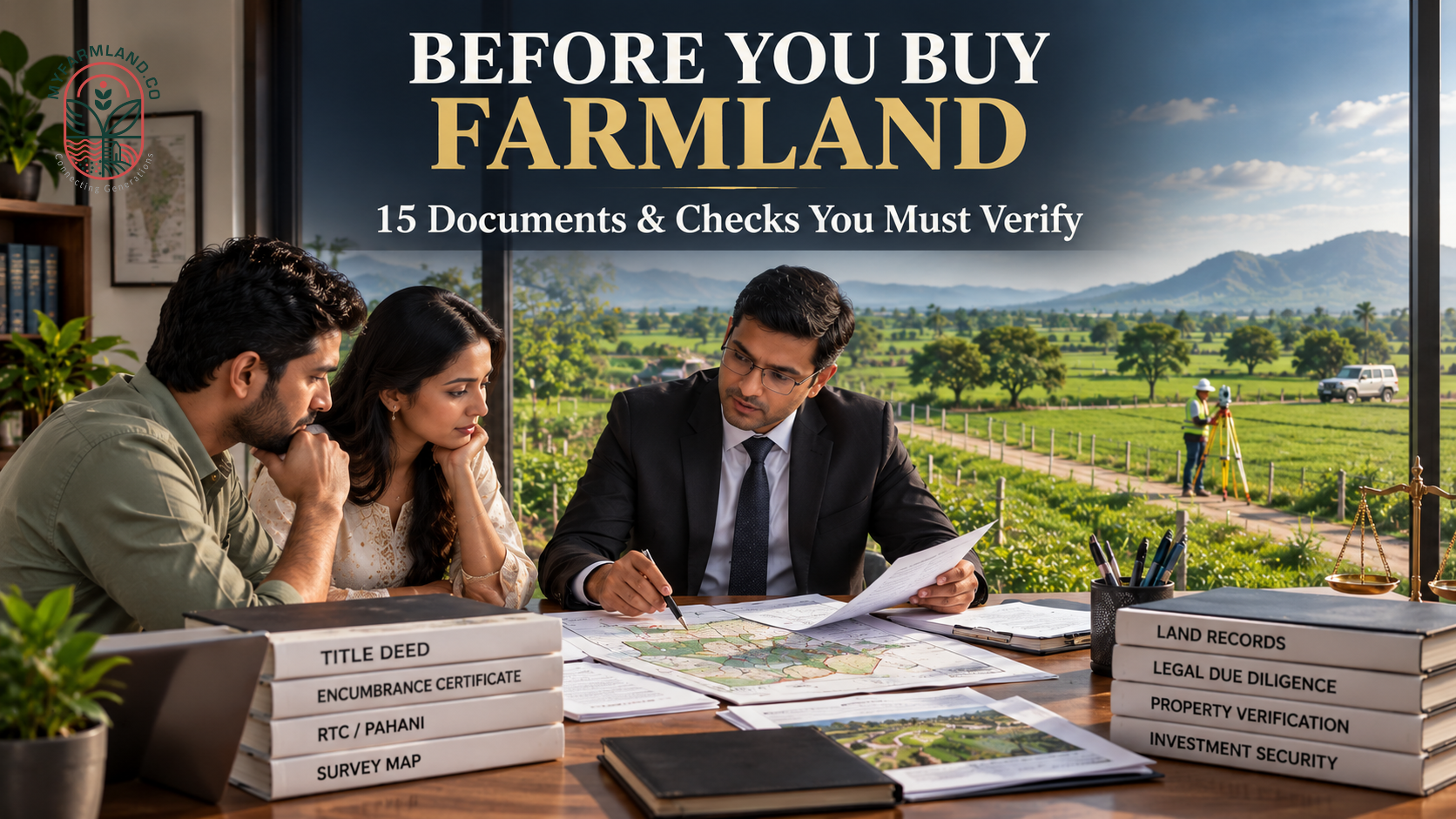
Farmland Buying Checklist: 15 Things to Check Before Paying an Advance
A beautiful piece of farmland can be tempting.
Green trees. A peaceful location. A wide road. A beautiful farmhouse. An attractive price.
But before you pay an advance, there is one question you should ask:
“Have I verified the land—or have I only seen the land?”
Buying agricultural land requires more than a site visit.
You need to understand the ownership, revenue records, survey details, access, land classification, restrictions and actual condition of the property.
This farmland buying checklist will help you understand the major checks you should consider before purchasing agricultural land in India.
Important: Land laws and required documents vary between states and individual properties. This is an educational checklist, not a substitute for independent legal advice.
1. Title Deed 📄
Start with the ownership document.
Check:
- Current owner's name
- Survey number
- Property extent
- Boundaries
- Previous transaction details
- Registration details
The person selling the land should have a legally transferable interest in the property.
Don't stop at the latest deed.
Ask your lawyer to examine the chain of title.
2. Parent Documents / Previous Title Chain
The current sale deed may not tell the complete story.
Depending on the property's history, previous documents may include:
- Earlier sale deeds
- Partition deeds
- Gift deeds
- Release deeds
- Inheritance documents
- Court orders
A proper title investigation should establish how the property reached the current owner.
Simple rule:
Current deed + previous ownership history = better understanding of title.
3. RTC / Pahani
For Karnataka agricultural land, check the RTC (Record of Rights, Tenancy and Crops), commonly known as Pahani.
Review information such as:
- Recorded holder
- Survey number
- Land extent
- Land classification
- Cultivation details
- Mutation information
The details should be consistent with the title documents.
🚩 If the documents show different survey numbers or extents, investigate before proceeding.
4. Encumbrance Certificate (EC)
An Encumbrance Certificate can help identify registered transactions and certain registered encumbrances affecting the property during the period searched.
Check the EC for:
- Registered mortgages
- Previous transactions
- Other registered encumbrances
But remember:
A clear EC does not automatically mean the title is perfect.
EC verification should be combined with a proper title search.
5. Mutation Records
Mutation records help track changes in revenue records following events such as sale, inheritance or partition.
Check whether:
- Previous ownership changes are reflected
- The current records are consistent
- The seller's details match the relevant documents
Any unexplained mismatch deserves further investigation.
6. Survey Number & Sub-Division Number
Never buy farmland based only on a project name or plot number.
Ask for the actual:
Survey Number
Sub-Division Number
Extent
Boundaries
This allows you to connect the physical property you are visiting with the underlying land records.
7. Physical Land Survey 📐
Documents alone aren't enough.
The physical property should also be checked.
A qualified surveyor can help establish:
- Actual boundaries
- Extent
- Encroachments
- Neighbouring boundaries
- Survey markers
- Whether the land shown to you corresponds to the records
This is particularly important for plotted farmland projects.
The plot shown in a brochure should correspond to the legally identifiable property.
8. Legal Access Road 🛣️
One of the most overlooked checks is access.
A road physically reaching the property does not necessarily mean you have a permanent legal right to use it.
Ask:
- Who owns the access road?
- Is it a public road?
- Is there a documented right of way?
- Is the access mentioned in relevant documents?
- Does the road cross another private property?
Remember:
Good road connectivity is useful. Legally documented access is essential.
9. Land Classification
Understand exactly what type of land you are purchasing.
Check the applicable revenue records and land classification.
Depending on the property, investigate whether there are:
- Agricultural-use restrictions
- Government restrictions
- Grant conditions
- Conversion requirements
- Special classifications
Never assume that every piece of rural land can be used in the same way.
10. Land Conversion / Diversion
This is critical if your intended use is different from agricultural activity.
For example, don't assume that purchasing agricultural land automatically permits:
- Residential construction
- Commercial buildings
- Resorts
- Farmstay operations
- Event venues
The permissions required depend on the state, location, applicable planning rules and intended use.
Before purchasing:
Ask:
“What can I legally do on this specific property?”
Get the answer in writing from the appropriate authority or qualified professional where necessary.
11. Water Availability 💧
For farmland, water is not a luxury.
It can directly affect:
- Crop selection
- Plantation
- Farm productivity
- Landscaping
- Livestock
- General usability
Check the actual water source:
- Borewell
- Open well
- Irrigation
- Rainwater
- Surface water
- Other permitted sources
Don't rely only on:
“There is plenty of water here.”
Visit and verify the situation.
12. Electricity & Infrastructure ⚡
Check what infrastructure actually exists at the property.
Ask about:
- Electricity connection
- Internal roads
- Drainage
- Fencing
- Water infrastructure
- Street lighting
- Security
For managed farmland projects, understand who owns and maintains the common infrastructure.
13. Litigation & Court Cases ⚖️
Before purchasing, conduct appropriate legal checks for disputes involving the property.
Investigate potential:
- Ownership disputes
- Partition disputes
- Family claims
- Court cases
- Acquisition proceedings
- Government claims
A lawyer should examine the available records and advise you based on the property's specific history.
14. Government Acquisition & Restrictions
Check whether the property is affected by:
- Proposed acquisition
- Existing acquisition proceedings
- Road widening
- Government projects
- Planning restrictions
- Environmental restrictions
- Other statutory limitations
Don't invest solely because someone says:
“A major highway is coming nearby.”
Verify important infrastructure claims through reliable official sources.
15. Seller & Transaction Verification
Finally, verify who is actually selling the property.
Check:
- Seller identity
- Ownership
- Authority to sell
- Power of Attorney, if applicable
- Company/developer authority, if applicable
- Payment recipient
- Agreement terms
Never transfer a large amount simply because a salesperson asks you to.
🚨 10 Red Flags You Should Never Ignore
Be extremely careful if you hear:
🚩 1. “Documents are not ready, but you can book today.”
🚩 2. “Don't worry about the survey number.”
🚩 3. “Everyone uses this road.”
🚩 4. “The conversion will happen later.”
🚩 5. “Guaranteed 3X returns.”
🚩 6. “Government approval is coming soon.”
🚩 7. “You don't need a lawyer.”
🚩 8. “Just pay the advance first.”
🚩 9. “The original documents will be shown after booking.”
🚩 10. “This is agricultural land, but you can build anything.”
Stop. Verify first.
Farmland Due Diligence Checklist
Save this checklist before visiting a property:
| Check | Status |
|---|---|
| Seller identity | ☐ |
| Current title deed | ☐ |
| Parent documents | ☐ |
| RTC / Pahani | ☐ |
| EC | ☐ |
| Mutation records | ☐ |
| Survey number | ☐ |
| Sub-division details | ☐ |
| Physical survey | ☐ |
| Legal access | ☐ |
| Land classification | ☐ |
| Conversion/diversion status | ☐ |
| Water source | ☐ |
| Electricity | ☐ |
| Litigation search | ☐ |
| Acquisition/restriction check | ☐ |
| Independent legal opinion | ☐ |
What About Managed Farmland Projects?
If you are considering a managed farmland community, add another layer of due diligence.
Ask:
Ownership
- What exactly am I purchasing?
- Will I receive a registered sale deed?
- What is the exact survey number?
Management
- Who manages the farmland?
- What services are included?
- What are the annual maintenance charges?
Plantation
- Who owns the crops/trees?
- Who maintains them?
- What happens if crops fail?
Construction
- Is construction permitted?
- What type of structure is permitted?
- What approvals are required?
Exit
- Can I resell?
- Are there transfer charges?
- Is there any lock-in?
These questions can help you understand the actual value proposition rather than relying only on the project's marketing material.
The 5 Golden Rules of Farmland Buying
If you remember nothing else from this article, remember these five:
1. Verify the Title
Know who owns the land.
2. Verify the Survey
Make sure the land you're buying is the land you're seeing.
3. Verify Access
Don't assume a visible road means legal access.
4. Verify Usage
Understand what you are legally allowed to do.
5. Verify Everything Before Paying
Never let urgency replace due diligence.
Final Word
Farmland can be more than an investment.
It can become a place for your family, a plantation, a weekend retreat or a long-term asset.
But the foundation should always be:
Clean Documents + Clear Ownership + Legal Access + Suitable Land + Proper Due Diligence
A beautiful property is only the beginning.
Before you buy the land, make sure you understand the land.
Explore farmland opportunities and buyer resources on MyFarmland.co.
⚠️ Legal Disclaimer
This article is intended for general educational purposes only and does not constitute legal, financial or investment advice. Land laws and procedures differ between states and properties. Buyers should obtain independent advice from a qualified property lawyer and verify records with the relevant authorities before entering into a transaction.