
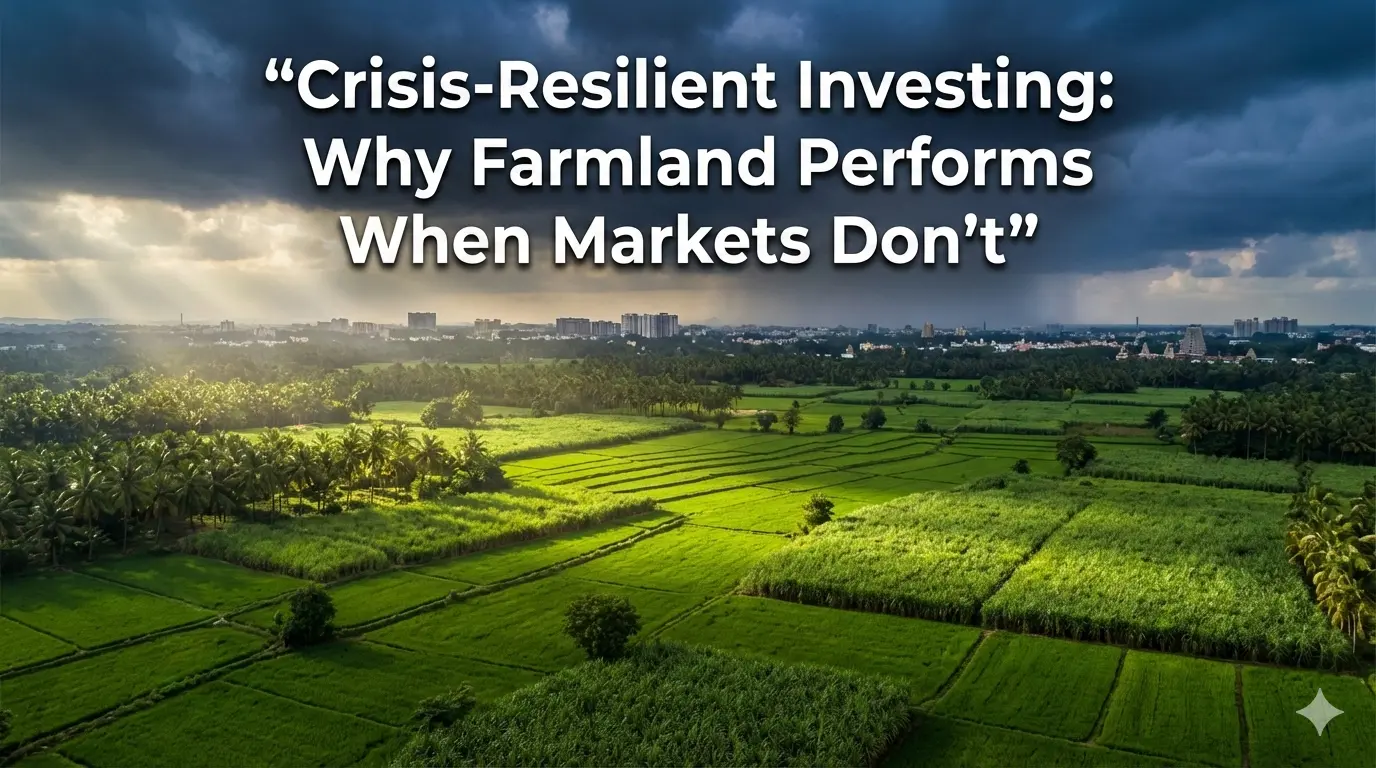
Crisis-Resilient Investing: Why Farmland Performs When Markets Don’t!
1️⃣ The Difference Between Productive Assets and Speculative Assets
Speculative assets depend on:
- Market sentiment
- Liquidity flow
- Investor psychology
Productive assets, on the other hand, generate value through utility.
Farmland is productive by nature. It supports:
- Food systems
- Plantation activity
- Resource management
Its value is tied to real-world demand — not just financial cycles.
2️⃣ Food Demand Doesn’t Pause During a Crisis
Economic downturns reduce luxury spending.
But they do not reduce:
- Food consumption
- Agricultural necessity
- Land utility
This constant baseline demand creates resilience.
While certain sectors contract, agriculture remains essential.
3️⃣ Lower Volatility Compared to Financial Markets
Public markets can move 5–10% in a single day.
Farmland does not.
Because:
- Transactions are slower
- Ownership is long-term
- Buyers are typically strategic
This reduces emotional volatility and forced selling.
4️⃣ Tangible Ownership During Uncertain Times
During global instability, investors often shift toward:
- Gold
- Physical assets
- Land
Why?
Because tangible ownership provides psychological security.
Farmland offers both:
- Real asset backing
- Functional utility
It is not just a paper investment.
5️⃣ Inflation and Supply Constraints
Crises often trigger inflationary pressures.
As inflation rises:
- Hard assets become attractive
- Land scarcity becomes more visible
- Replacement costs increase
Farmland benefits from these macroeconomic shifts.
6️⃣ Limited Leverage Pressure
Unlike urban apartments that often involve high EMIs and leveraged loans, farmland investments are frequently:
- Lower leveraged
- Long-horizon based
- Not rental-dependent
This reduces financial stress during downturns.
7️⃣ Regional Growth Continues Beyond Cycles
Even during slow economic phases:
- Infrastructure projects continue
- Industrial corridors develop
- Urban expansion gradually progresses
Farmland positioned near growth corridors continues to benefit over time.
The Strategic Insight
Crisis-resistant investing is not about avoiding risk entirely.
It is about owning assets that:
- Retain utility
- Maintain demand
- Avoid extreme volatility
- Align with essential sectors
Farmland checks these boxes.
Final Thought
Farmland is not designed for rapid appreciation.
It is designed for durability.
When markets become unpredictable, stability becomes valuable.
And assets tied to essentials — land, food, space — tend to endure.
In investing, resilience is underrated. Farmland quietly delivers it.