
15 Farmland Buying Mistakes to Avoid in India 15 Farmland Buying Mistakes to Avoid in India Before You Invest.
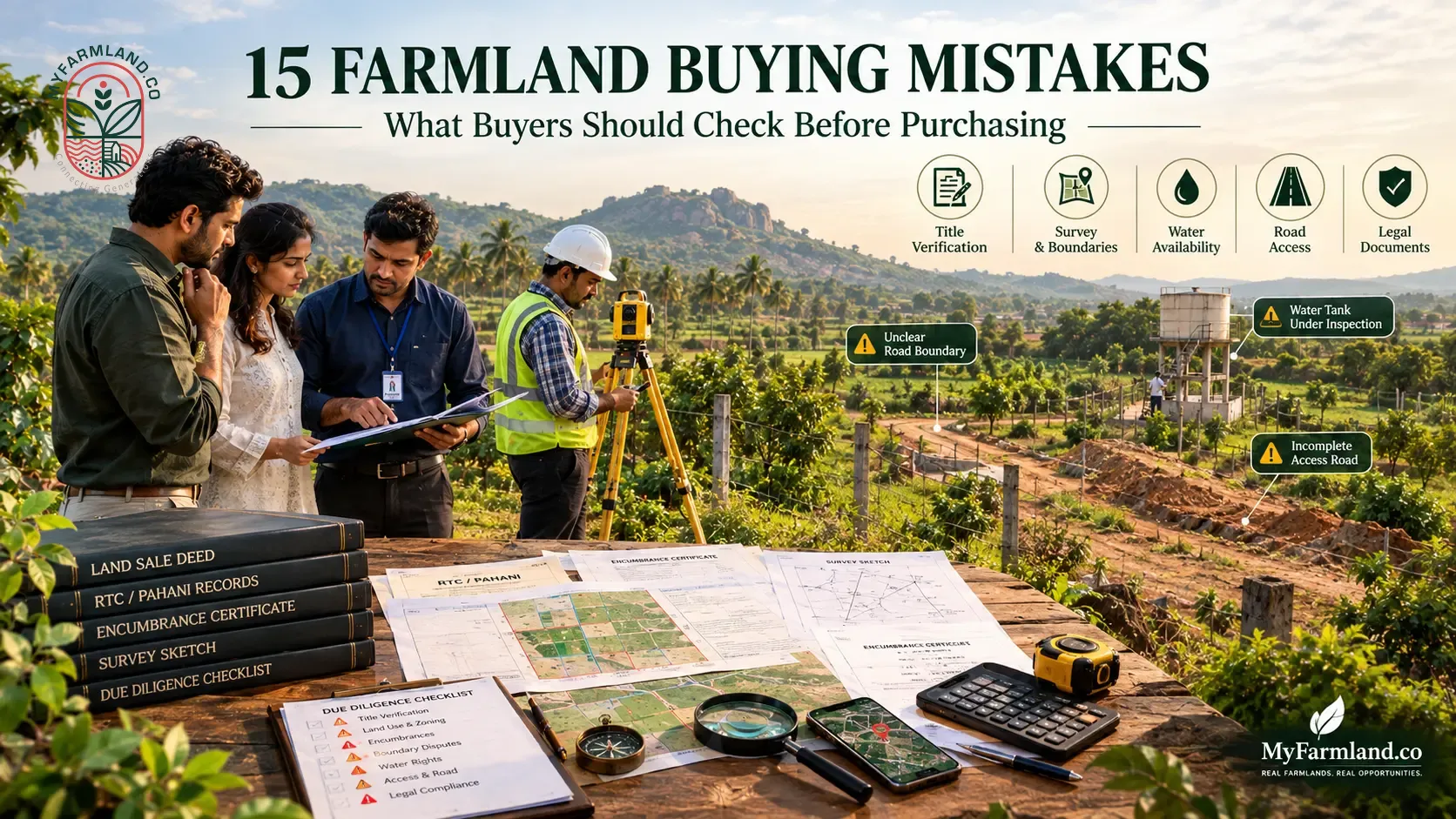
But farmland is different from buying a typical apartment or residential plot.
A buyer needs to consider title, land records, access, water, land use, development, management, total cost and future usability before making a decision.
Many problems happen because buyers focus on the location, price or amenities first and verify the underlying property later.
This guide covers 15 common farmland buying mistakes and explains what buyers can do instead.
Important: “Farmland” and “managed farmland” are not substitutes for legal due diligence. The exact rights, permitted uses and project structure depend on the property and applicable laws.
1. Buying Farmland Only Because the Price Looks Cheap
A low price per square foot can be attractive.
But price alone does not tell you whether the property is a good purchase.
A cheaper parcel may have issues involving:
- Poor road access
- Water availability
- Unclear title
- Difficult boundaries
- Development restrictions
- Distance from usable roads
- Land-use limitations
- Difficult resale
- Additional development costs
Instead of asking only:
“What is the price per sq ft?”
also ask:
“What am I getting for the total amount I will spend?”
Better approach
Calculate:
Land price + registration costs + development charges + infrastructure charges + maintenance + legal verification + other applicable expenses
Then compare properties based on the complete acquisition cost.
2. Assuming the Location Is More Important Than the Documents
A beautiful location can make a property look attractive.
A property may be close to a highway, city, airport or major development corridor.
But connectivity does not replace legal verification.
Before purchasing, verify:
- Seller ownership
- Title chain
- Survey number
- RTC/Pahani
- Mutation
- Encumbrance Certificate
- Survey sketch
- Access rights
- Land classification
- Applicable restrictions
For certain development applications in Karnataka, government regulations themselves list documents such as RTC, mutation extract, sale deed, EC and survey sketch among the revenue documents required for applications.
Better approach
Documents first. Location potential second.
Both matter, but they answer different questions.
3. Not Checking the Exact Survey Number
This is one of the most important practical checks.
A brochure may show a large project boundary, while your actual purchase relates to a particular survey number or subdivision.
You should establish:
- Survey number
- Subdivision number, if applicable
- Exact extent
- Boundaries
- Location on the ground
- Relationship to the registered document
The government-backed Karnataka Land Resources Information system also provides survey-number-based information relating to soil, crops, land suitability and watershed layers, showing why identifying the exact survey number is important for property-level investigation.
Better approach
Match:
Sale deed → RTC/Pahani → survey sketch → physical property
The information should be consistent.
4. Ignoring the Title History
Looking only at the current owner's name is not always enough.
A buyer should understand how the property reached the current owner.
Depending on the property, this may involve:
- Previous sale deeds
- Partition documents
- Gift deeds
- Release deeds
- Inheritance documents
- Grant-related documents
- Court orders
- Mutation records
Better approach
Ask for the relevant title chain and have an independent property lawyer examine it.
Do not rely solely on a verbal statement such as:
“The land has a clear title.”
Ask to see the documents supporting that statement.
5. Checking the EC but Not the Rest of the Documents
An Encumbrance Certificate can be an important part of property due diligence.
But an EC should not be treated as a complete substitute for title verification.
A buyer should examine multiple records together.
| Document / Check | What it helps you investigate |
|---|---|
| Sale deed | Current transaction/title document |
| Previous deeds | Historical ownership |
| RTC/Pahani | Revenue and land record information |
| Mutation | Changes reflected in revenue records |
| EC | Registered transactions/encumbrances within its scope |
| Survey sketch | Survey and boundary information |
| Physical survey | Ground-level verification |
| Land classification | Nature/use of the land |
| Court/litigation search | Potential disputes |
| Access verification | Physical and legal access |
Better approach
Think of due diligence as a system of checks, not a single certificate.
6. Assuming You Can Build Whatever You Want
This is a common farmland buying mistake.
A marketing brochure may show:
- Farmhouse
- Cottage
- Villa
- Cabin
- Pool
- Guest accommodation
That does not automatically mean every buyer has unrestricted construction rights.
In Karnataka, agricultural land use and diversion are regulated under the Karnataka Land Revenue Act, and applicable permissions depend on the nature and proposed use of the property.
Better approach
Before buying, ask:
- What construction is permitted?
- Is conversion/diversion required?
- Has any required permission already been obtained?
- Which authority handles building permission?
- Are there project-specific restrictions?
- Can an outside contractor construct?
- Does the developer control construction?
- Are farmstay or rental activities permitted?
Get project-specific answers and documents rather than relying on advertisements.
7. Ignoring Water Availability
For farmland, water is not a minor amenity.
It can affect:
- Crop selection
- Plantation survival
- Farm productivity
- Maintenance costs
- Land usability
- Long-term agricultural plans
Ask:
- What is the water source?
- Is it individual or common?
- How deep are the borewells?
- What happens during summer?
- Is there water storage?
- Is drip irrigation available?
- Who pays for maintenance?
- Is there a backup water source?
The Karnataka government's Land Resources Information portal includes soil, crop suitability and watershed information, which can provide additional context when evaluating agricultural land.
Better approach
Visit the property during different seasons where practical and ask for actual information rather than judging water availability only from landscaping.
8. Not Checking the Road Access Properly
A property can look close to a main road on a map but still have difficult final access.
Check:
- Main road connectivity
- Internal road
- Width of access road
- Ownership/status of the access road
- Whether access is recorded or legally established
- Monsoon accessibility
- Emergency vehicle access
- Road maintenance responsibility
Better approach
Drive the entire route from the nearest major road to the property.
Do not stop at the main gate.
9. Confusing Amenities With Property Value
Clubhouses, pools, sports areas, landscaping and other facilities can make a farmland project attractive.
But amenities should not distract from the underlying land.
Compare two projects based on:
Property
- Title
- Survey
- Land extent
- Water
- Access
- Location
Development
- Roads
- Fencing
- Electricity
- Irrigation
- Plantation
- Drainage
Management
- Farm maintenance
- Security
- Agricultural services
- Annual maintenance
- Management agreement
Amenities
- Clubhouse
- Recreation
- Farmstay
- Sports facilities
- Common areas
This creates a more balanced comparison.
10. Not Understanding the Management Agreement
This is particularly important for managed farmland.
A buyer may hear:
“We will take care of everything.”
But what exactly does “everything” mean?
The management agreement should clarify:
- Who manages the farm?
- What services are included?
- What is the management period?
- What is the annual fee?
- Who pays for irrigation?
- Who pays for labour?
- Who replaces dead plants?
- Who owns the produce?
- How is harvesting handled?
- Can the owner change the farm manager?
- What happens if management stops?
Better approach
Never evaluate managed farmland solely from the brochure.
Read the actual agreement.
11. Believing Guaranteed Return Claims
Statements such as:
- “Guaranteed appreciation”
- “Guaranteed monthly income”
- “Double your money”
- “Guaranteed rental”
- “Fixed agricultural income”
should be examined carefully.
Land values can change because of:
- Demand
- Infrastructure
- Local development
- Regulatory changes
- Market conditions
- Accessibility
- Supply
- Economic conditions
Agricultural income can also vary because of:
- Weather
- Water
- Crop disease
- Labour
- Input prices
- Crop prices
- Yield
Better approach
Ask:
“What is the calculation behind this projection?”
Then ask:
“What happens if the assumptions do not occur?”
A projection is not the same thing as a guarantee.
12. Buying Without Visiting the Property
Online photographs, videos, drone footage and maps are useful.
But they cannot replace a physical inspection.
During your visit, inspect:
- Road
- Boundary
- Terrain
- Soil
- Water infrastructure
- Electricity
- Existing plantation
- Drainage
- Nearby development
- Surrounding land use
- Mobile connectivity
- Actual travel time
Better approach
Visit more than once if the investment is significant.
Ideally, inspect the property with:
- A property representative
- A survey professional when necessary
- An independent lawyer for document review
- Someone with agricultural knowledge when evaluating farming potential
13. Ignoring the Surrounding Land
The property itself is only part of the picture.
Look around the project.
Check:
- Nearby villages
- Existing farms
- Industrial areas
- Highways
- Large infrastructure projects
- Water bodies
- Forest boundaries
- Quarrying activity
- Power infrastructure
- Future development
- Other agricultural projects
The surrounding environment can affect both the agricultural experience and future usability of the property.
Better approach
Spend time exploring the surrounding area rather than visiting only the project entrance.
14. Forgetting About the Total Annual Cost
Many buyers calculate the purchase price but forget the recurring cost of ownership.
Potential recurring expenses may include:
- Farm management
- Plantation maintenance
- Irrigation
- Security
- Common-area maintenance
- Electricity
- Road maintenance
- Tree replacement
- Property-related taxes/charges where applicable
Create a simple five-year ownership estimate.
Example
| Cost | Year 1 | Year 2 | Year 3 | Year 4 | Year 5 |
|---|---|---|---|---|---|
| Maintenance | ₹— | ₹— | ₹— | ₹— | ₹— |
| Farm management | ₹— | ₹— | ₹— | ₹— | ₹— |
| Irrigation | ₹— | ₹— | ₹— | ₹— | ₹— |
| Other charges | ₹— | ₹— | ₹— | ₹— | ₹— |
| Total | ₹— | ₹— | ₹— | ₹— | ₹— |
Use the actual project's numbers rather than relying on generic estimates.
15. Rushing Because of “Limited Plots”
Limited inventory can be a legitimate commercial fact.
But urgency should not replace due diligence.
Statements such as:
- “Only 5 plots left”
- “Price increases tomorrow”
- “Last opportunity”
- “Book immediately”
- “Only today”
should not prevent you from checking the documents.
Better approach
Use this rule:
Never skip legal verification because of sales urgency.
A genuine opportunity should still be evaluated carefully.
The 3-Layer Farmland Due Diligence Framework
Before purchasing, divide your research into three layers.
Layer 1 — Legal
Verify:
Ownership → Title → RTC/Pahani → Mutation → EC → Survey → Land classification → Access → Restrictions
Layer 2 — Physical
Inspect:
Road → Boundary → Water → Soil → Terrain → Electricity → Drainage → Surroundings → Actual development
Layer 3 — Commercial
Understand:
Price → Total cost → Maintenance → Management → Construction → Resale → Agricultural plan → Exit options
A property should make sense across all three layers.
Managed Farmland: Additional Checks
If you are considering managed farmland, add another layer:
Management Due Diligence
Ask:
- Who manages the farm?
- What experience does the operator have?
- What exactly is included?
- What is excluded?
- What is the annual fee?
- Is there a written management agreement?
- How long does it remain valid?
- Who owns the crops?
- Who receives harvest proceeds?
- What happens if the management company changes?
- Can the owner terminate the agreement?
- Can the owner appoint another operator?
This is one of the biggest differences between buying a conventional agricultural parcel and participating in a managed farmland project.
A Simple Farmland Buying Scorecard
Instead of looking only at price, create your own factual comparison sheet.
| Factor | Project A | Project B | Project C |
|---|---|---|---|
| Location | |||
| Total price | |||
| Plot size | |||
| Title documents | |||
| RTC/Pahani | |||
| EC | |||
| Survey verification | |||
| Road access | |||
| Water | |||
| Electricity | |||
| Development | |||
| Plantation | |||
| Maintenance | |||
| Management | |||
| Construction rules | |||
| Resale process | |||
| Legal review |
This allows buyers to compare projects based on documented information rather than marketing claims.
What Should You Do Before Paying a Booking Amount?
Use this sequence:
Step 1
Visit the property.
Step 2
Collect the exact survey and property details.
Step 3
Request the relevant title and revenue documents.
Step 4
Review the management/project agreement if applicable.
Step 5
Verify access, water and physical boundaries.
Step 6
Calculate the complete purchase and ownership cost.
Step 7
Ask about construction and future use.
Step 8
Have an independent property lawyer review the documents.
Step 9
Clarify the cancellation/refund terms for the booking amount.
Step 10
Only then decide whether the property fits your requirements.
Farmland Buying Mistakes: Quick Checklist
Before purchasing, ask yourself:
- Did I verify the actual owner?
- Did I check the title history?
- Did I verify the survey number?
- Did I review RTC/Pahani?
- Did I check the EC?
- Did I investigate mutation records?
- Did I physically inspect the land?
- Did I verify legal/actual road access?
- Did I understand the water source?
- Did I check applicable land-use restrictions?
- Did I understand construction rules?
- Did I calculate total costs?
- Did I understand maintenance charges?
- Did I read the management agreement?
- Did an independent professional review the documents?
Frequently Asked Questions
What is the biggest mistake when buying farmland?
There is no single mistake that applies to every transaction. Common problems include insufficient title verification, ignoring access and water, misunderstanding land-use restrictions, and relying on return claims without examining the assumptions.
Should I buy farmland based on the lowest price?
Price should be only one part of the comparison. Legal status, location, access, water, development and total ownership cost also matter.
Is an EC enough to verify farmland?
No. An EC is one component of property due diligence. Buyers should examine the title chain, revenue records, survey information and other applicable records.
Can I construct a farmhouse on agricultural land?
Do not assume that construction is automatically permitted. The applicable land-use rules, conversion status and permissions must be checked for the specific property.
What should I check in managed farmland?
In addition to normal land due diligence, examine the management agreement, maintenance fee, farming plan, responsibilities of the operator, ownership of produce and termination/resale provisions.
Should I visit farmland before buying?
A physical visit is strongly useful because documents and photographs cannot show every aspect of road access, boundaries, water infrastructure, terrain and surrounding land use.
Are farmland returns guaranteed?
No investment outcome should be assumed to be guaranteed simply because it is farmland. Land appreciation and agricultural income depend on multiple factors.
Final Thoughts
Buying farmland requires a different mindset from buying a conventional residential property.
The attractive landscape is only the beginning.
A proper evaluation should connect:
LEGAL → PHYSICAL → AGRICULTURAL → COMMERCIAL
The most important question is not simply:
“Does this farmland look attractive?”
It is:
“Can I independently verify what I am buying, what I can use it for, what it will cost me, and how it will be managed?”
Taking time for due diligence can help buyers identify unanswered questions before committing money.
For buyers researching farmland projects, platforms such as MyFarmland.co can be used for project discovery and comparison, while legal, technical and financial verification should be completed independently before purchase.
/farmland-buying-mistakes/
Legal Disclaimer
This article is for general educational purposes and is not legal, financial, tax or investment advice. Land laws and local development regulations can change, and requirements can vary by location and property type. Buyers should verify the latest applicable rules and obtain independent advice from a qualified property lawyer and relevant authorities before entering into a land transaction.
Karnataka government sources identify revenue and survey documents such as RTC, mutation records, sale deeds, EC and survey sketches in relevant land-development processes, while the state's land-resource portal provides survey-level agricultural and land-resource information.